
Nitriding and QPQ
Anodizing & conversion coatings · Thermal
Nitriding diffuses nitrogen into steel to create a hard wear-resistant case without depositing a conventional coating.
Reference page — Nitriding is not in the instant-quote configurator. Upload the part, name the finish in the notes, and an engineer quotes it with the part.
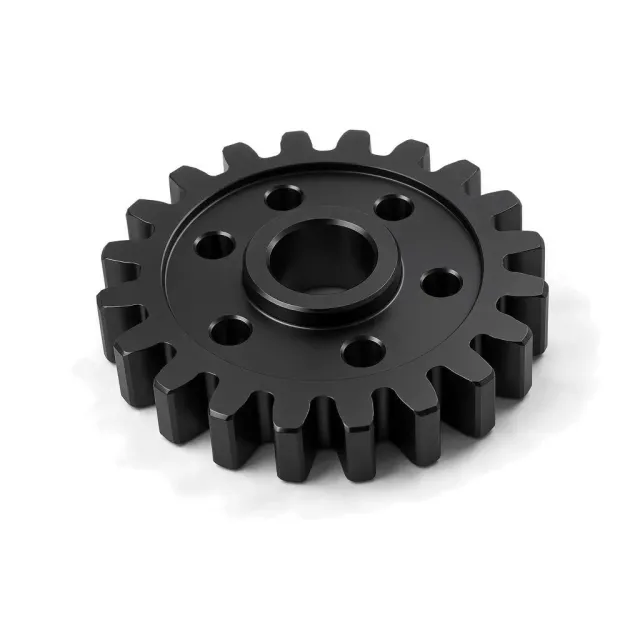
What is Nitriding?
Gas, plasma, and salt-bath nitrocarburizing or QPQ are selected for gears, shafts, dies, moulds, and firearm components.
How it works
Gas or plasma nitriding holds alloy steel in a nitrogen-active atmosphere, commonly around 480–580 °C, so nitrogen diffuses inward and forms alloy nitrides. Salt-bath ferritic nitrocarburizing runs near 570–590 °C and forms a thin compound layer over a diffusion zone; QPQ adds polish and post-oxidation. The case is supported by the core, so steel chemistry and prior heat treatment control the result.
Why specify it
- Surface hardness commonly 700–1200 HV
- Case depth about 0.1–0.7 mm
- Low distortion compared with carburizing
- QPQ adds black appearance and corrosion resistance
Where it falls short
- Works mainly on suitable ferrous alloys
- Compound layer can be brittle if excessive
- Process heat can alter prior temper
- Case depth requires long cycles
Nitriding at a glance
Nitriding is strongest on surface hardness (73 of 100), at a high cost.
Each score is 0–100 against every finish in this catalog. Corrosion comes from salt-spray life (ASTM B117, log scale) and hardness from the finish layer's Vickers or pencil hardness; cosmetic, lubricity and cost are FabDigit's engineering assessment. Economy on the radar is the inverse of cost.
Nitriding key numbers
Typical values from the governing specifications and shop practice; bars are this finish against the highest value among anodizing & conversion coatings finishes.
- Thickness
- Compound (white) layer about 5–20 µm over a 0.1–0.7 mm diffusion case; salt-bath QPQ can sit at the high end.
- Hardness
- 700–1,200 HV — Grade- and process-dependent surface hardness.
- Electrical
- Unchanged
- Colours
- silver-grey
- black QPQ
- Appearance
- Grey after gas or plasma nitriding; uniform black after polished post-oxidized QPQ.
Where Nitriding sits among all finishes
Surface hardness (Vickers, log scale) against corrosion protection (salt-spray hours, log scale) for every coating FabDigit offers, one cloud per finish group. Nitriding is highlighted; hover a dot for its name or open the full map.
Specifications for Nitriding
The documents a drawing cites to define this finish, with the Type / Class rows that apply. Each links to a page explaining the standard.
Drawing call-out
PLASMA NITRIDE DESIGNATED SURFACES, EFFECTIVE CASE DEPTH 0.30–0.50 mm, SURFACE HARDNESS 900 HV0.5 MIN, COMPOUND LAYER 5–15 µm; MASK THREADS; DISTORTION 0.02 mm MAXWhich materials take Nitriding?
Verdict per material family, with the grades that behave differently. Each family links to its datasheets in the material library.
| Material family | Verdict | Notes |
|---|---|---|
| Yes | Alloy and tool steels designed for nitriding give the best response.
| |
| With care | Steel DMLS/SLM parts can be nitrided after density, residual-stress, and prior-temper review. | |
| With care | Special low-temperature plasma processes may preserve corrosion resistance; conventional treatment can reduce it. | |
| Limited | Titanium nitriding is a different specialized diffusion process. | |
| No | This record covers ferrous nitriding, not aluminum nitride deposition. | |
| No | Brass is incompatible with nitriding. | |
| No | Copper alloys do not form a useful nitrided case in this process. | |
| No | Polymers cannot be nitrided. | |
| No | Process temperature and chemistry are incompatible. | |
| No | Polymers cannot be nitrided. | |
| No | Process temperature and mechanism are incompatible. | |
| No | Polymers cannot be nitrided. | |
| No | Polymers cannot be nitrided. | |
| No | Process temperature exceeds zinc-alloy limits. |
How Nitriding is applied, and what it does to the part
- 1Select and heat-treat steel
- 2Clean
- 3Mask or stop off
- 4Gas, plasma, or salt-bath treat
- 5Diffuse or quench
- 6Polish and oxidize for QPQ
- 7Inspect hardness and case depth
| Dimensions | Growth is far below a plated case depth but is not zero; leave finish-grind allowance and qualify distortion on precision parts. |
|---|---|
| Build-up per side | 0–10 µm — Diffusion causes little buildup; QPQ compound-layer growth and swelling are process-specific. |
| Masking | Usually needed. Stop off threads, sharp edges, weld zones, and surfaces that must remain machinable or soft. |
| Electrical | Unchanged |
| Temperature limit | 500 °C (932 °F) continuous |
| Appearance | Grey after gas or plasma nitriding; uniform black after polished post-oxidized QPQ. |
| Added lead time | 7–15 working days on top of the bare part |
Design rules for Nitriding
What to decide on the drawing before the part goes to the finisher.
- Name gas, plasma, or QPQ.The processes do not produce interchangeable cases.
- Specify effective case depth and hardness load.Surface hardness alone does not define load support.
- Choose a nitriding steel.Chromium, molybdenum, aluminum, and vanadium improve nitride response.
- Set compound-layer limits.An excessive white layer can be brittle.
Nitriding versus the alternatives
Finishes engineers weigh against Nitriding, and when each wins.
| Finish | Corrosion | Hardness | Cosmetic | Cost | Thickness | Choose it when |
|---|---|---|---|---|---|---|
Nitriding this page | 55 | 73 | 55 | $$$$ | 5–20 µm | — |
| 55 | 93 | 72 | $$$$ | 1–3 µm | lower friction with only micrometre buildup is required | |
| 45 | 87 | 88 | $$$$ | 1–5 µm | a deposited hard film is preferred |
The radar overlays Nitriding with Diamond-Like Carbon Coating, its most common alternative — chosen lower friction with only micrometre buildup is required. Scores in the table are 0–100 across every finish in the catalog.
Cost, lead time and compliance
Relative cost
Nitriding and QPQ is a high-cost finish ($$$$): more expensive than about 77 % of the finishes FabDigit quotes.
Finishing is priced per part with a lot minimum, from FabDigit's own China-side rates. The exact figure appears on the instant quote once the part is uploaded.
Lead time and compliance
| Added lead time | 7–15 working days |
|---|---|
| RoHS | Compliant |
| Notes | Final nitrided steel is generally RoHS-compatible; salt-bath chemistry and gas handling require controlled industrial processing. |
What Nitriding is used for
- Gears
- Pump shafts
- Extrusion dies
- Injection moulds
Nitriding — frequently asked
How deep is a nitrided case?
Typical engineering case depth is about 0.1–0.7 mm. Compound layer at the surface is much thinner, commonly about 5–20 µm.
How hard is nitrided steel?
Surface hardness is commonly 700–1200 HV depending on steel and process. Case depth and core hardness are equally important.
Gas nitriding vs plasma nitriding: what is the difference?
Both diffuse nitrogen, usually around 480–580 °C. Plasma offers selective control and reduced gas use, while gas nitriding is established for larger batch loads.
What is QPQ nitriding?
QPQ is salt-bath ferritic nitrocarburizing followed by polishing and post-oxidation. It produces a black surface, a thin compound layer, and a diffusion case.
Does nitriding change dimensions?
It has much less growth than a 50–300 µm sprayed coating, but growth and distortion are not zero. Precision parts should include a qualified grind or size allowance.
Other anodizing & conversion coatings finishes
 Anodizing Type IIType II sulfuric anodizing converts aluminum into a porous aluminum-oxide coating that can be clear or dyed.CorrosionHardnessCost$$
 Boric-Sulfuric Acid Anodizing Type ICBoric-sulfuric acid anodizing is a thin aerospace aluminum anodize recognized as MIL-A-8625 Type IC.CorrosionHardnessCost$$$
 Chemical Conversion CoatingChem film is a thin chemical conversion coating for aluminum that improves corrosion resistance while retaining useful electrical conductivity.CorrosionHardnessCost$
 Chromic Acid Anodizing Type IType I and low-voltage Type IB chromic-acid anodizing form thin, corrosion-resistant oxide on aluminum with less fatigue penalty than thick sulfuric anodize.CorrosionHardnessCost$$$
 Hard Anodizing Type IIIType III hard anodizing forms a thick, dense aluminum-oxide layer for sliding, abrasive, and high-load service.CorrosionHardnessCost$$$
 Hard Anodizing Type III With PTFEPTFE hard anodize combines a 25–75 µm Type III oxide with a fluoropolymer impregnation or post-treatment to reduce friction.CorrosionHardnessCost$$$
 Magnesium Chemical Conversion CoatingMagnesium conversion coating reacts with magnesium alloys to improve corrosion resistance and paint adhesion with minimal buildup.CorrosionHardnessCost$$$
 Plasma Electrolytic OxidationPlasma electrolytic oxidation, also called micro-arc oxidation, creates a thick ceramic oxide on aluminum or magnesium using high-voltage micro-discharges.CorrosionHardnessCost$$$$
Compare every anodizing & conversion coatings finish side by side →