FabDigit
Medical Devices

Built sterile. Built traceable. Built for the chart.

Implants, surgical instruments, capital-equipment housings, disposables, and high-reliability electronics for medical-device platforms. From a single clinical build to validated production lots — built to your biocompatibility, sterilization, and regulatory envelope.

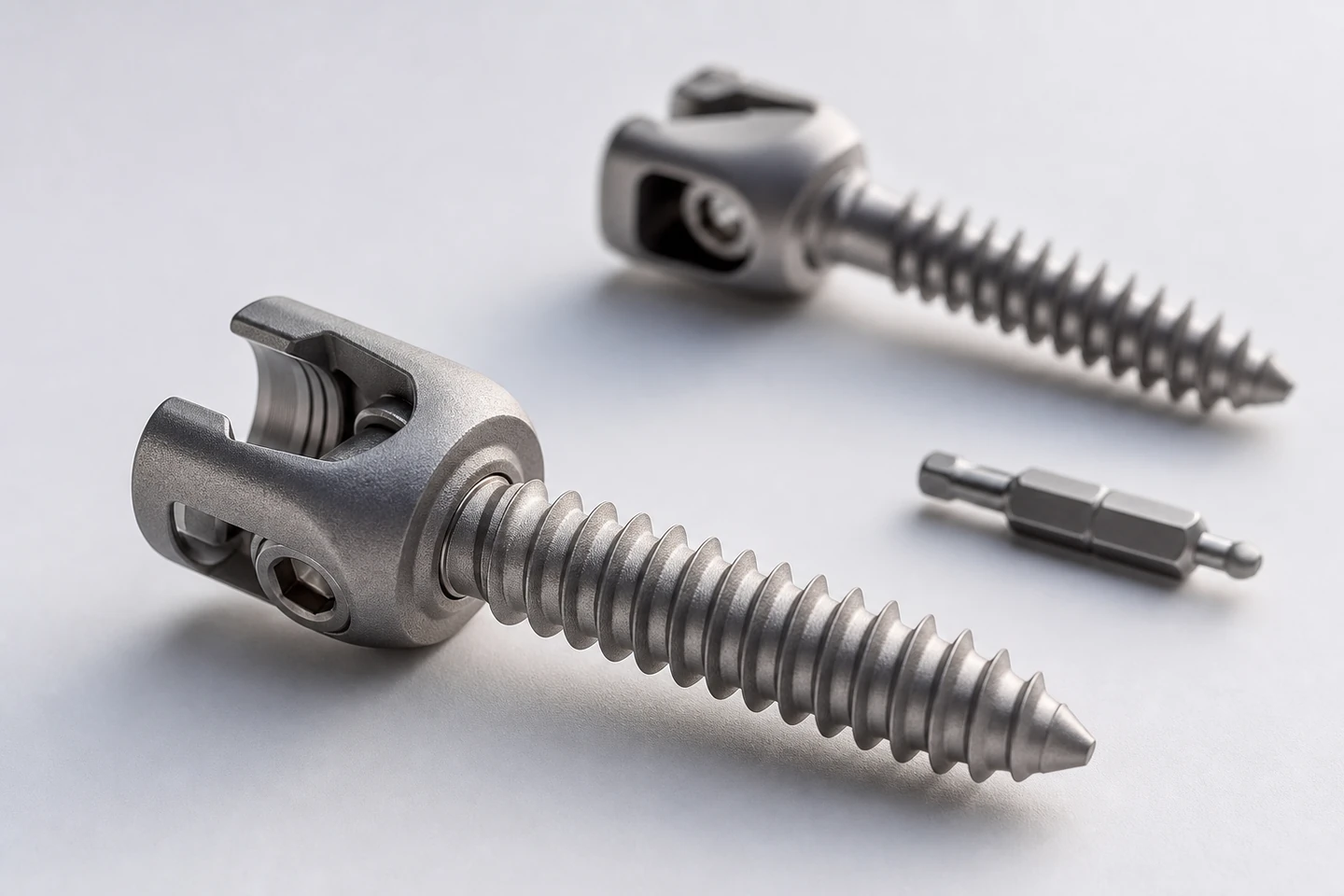
Titanium polyaxial spinal pedicle-screw implant on a light-grey backdrop
What makes this hard

Three engineering realities every medical program eventually meets.

Medical devices fail differently from every other product category. Biocompatibility, sterilization compatibility, and regulatory traceability compound — and the parts that ship are the ones designed against all three from CAD onwards, not retrofitted to certification.

Biocompatibility starts with the material certificate.

ISO 10993 isn’t a downstream qualification — it’s a material-selection problem you solve in CAD. We work from ASTM F136 ELI-grade titanium, ISO 5832-3 / -6 stainless, USP Class VI polymers from day one.
Sterilization eats some materials and oxidizes others.

Autoclave kills POM. Gamma kills PP. EtO leaves residue. We design the housing, the seal, and the bonding stack against the actual sterilization cycle you’ll use — not against the spec sheet.

Traceability is the BoM. The BoM is the traceability.

21 CFR 820, ISO 13485, MDR — each demands per-lot heat traceability, cleanroom passport, and a DHF that closes. We build the BoM into the audit pack, not into the apology email.

Capability envelope

What we typically ship — and where the regulatory moat sits.

Working ranges across recent medical-device programs. Coatings row carries the moat: cleanroom passivation, electropolish, and PVD lines restricted on US/EU sites that our partner plants still run.

Mechanical tolerance
On implants and articulating instruments.
±0.025 → ±0.005 mm
Clinical-build lead time
CAD-frozen → first units for surgeon trials.
18 – 42 days
Clinical lot size
Engineering + clinical-trial lots.
10 – 300 units
Production cell size
Validated per-week throughput, sustained.
1,000 – 10,000 units / wk
Surface roughness
On articulating implant surfaces (Ra).
0.1 – 0.4 µm Ra
Coatings & finishes
Biocompatible surface treatments used routinely on medical hardware. Restricted-elsewhere lines marked with a flag.
Electropolish (stainless / Ti)Passivation (ASTM A967)PVD TiN / TiCN (instruments)DLC (instrument wear)Anodise Type II decorativeBead-blast surgical-matteSelective gold plate, ECG / EEGPlasma-spray HAp (implants)EUSulfochromate passivationUSPowder coat, IEC 60601-cleanable
A reference build

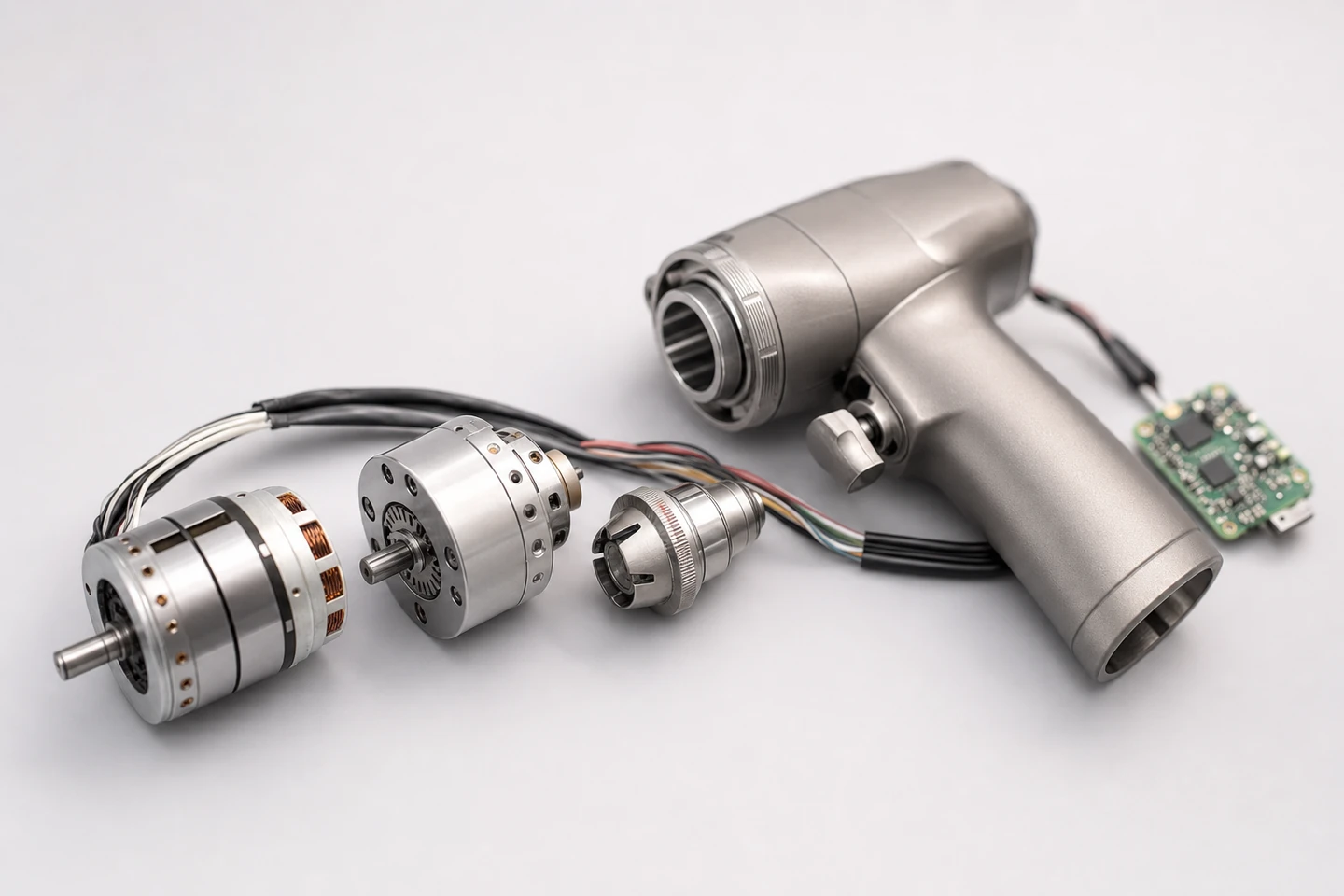
Anatomy of a surgical-power-tool handpiece.

Composite of recent surgical-handpiece programs — high-RPM brushless drive, sealed for autoclave, sterilizable between procedures. Each callout is where engineering trade-offs actually live.

Disassembled surgical handpiece showing motor, gearbox, chuck, and housing
01 · BLDC motor
02 · Planetary gearbox
03 · Quick-connect chuck
04 · Titanium housing
05 · Control PCB
06 · Service cable
  1. 01

    1 · High-RPM BLDC motor

    Custom 60 k RPM brushless motor, sealed-bearing both ends. Insulation system rated for 134 °C steam autoclave; encoder PCB inside the housing.

  2. 02

    2 · Sealed planetary gearbox

    Hardened-steel planetary set with food-grade autoclave-safe grease pre-filled. Triple-lip dynamic seals; bore concentricity 0.005 mm.

  3. 03

    3 · Quick-connect chuck

    Surgeon-actuated quick-connect for swap of drill bits, burrs, and saw blades. Stainless 17-4 PH, electropolished, passivated.

  4. 04

    4 · Bead-blast Ti housing

    CNC titanium housing, bead-blasted to surgical-matte. IPX7-class sealed; ergonomic grip profile fluid-honed.

  5. 05

    5 · Motor controller PCB

    6-layer FOC motor controller, IEC 60601-compliant trace spacing, conformal-coated, hot-side designed for ≥1,000 autoclave cycles.

  6. 06

    6 · Silicone service cable

    USP Class VI silicone-jacketed cable with autoclave-safe sealed over-mould. Custom pin-out, surgical-grade strain reliefs.

Parts we ship most

Six part archetypes that drive a medical-device BoM.

These six archetypes make up the majority of the spend on a typical medical-device program. Spec ranges below are working envelopes — your drawing tightens them.

Implant

Orthopaedic / spinal / dental titanium implants. Bead-blast or PEEK + HAp combinations available. SLM porous-lattice cages on request.

Material
Ti-6Al-4V ELI · Co-Cr-Mo · PEEK
Process
5-axis CNC + SLM
Tolerance
±0.01 mm
Run size
50 – 5,000 pcs

Surgical instrument

Articulating, single-action, and powered surgical instruments. 17-4 PH stainless, electropolish + passivation.

Material
17-4 PH · 316L · Ti
Process
CNC + EDM
Tolerance
±0.015 mm
Run size
50 – 10,000 pcs

Capital-equipment housing

Imaging carts, infusion-pump bodies, anaesthesia front panels. Sheet aluminum or injection-moulded PSU / PEI.

Material
5052 Al · PSU · PEI
Process
Sheet + IM
Tolerance
±0.1 mm
Run size
50 – 5,000 pcs

Disposable fluid path

Single-use fluid-path cassettes, IV-set valves, dialysis cartridges. USP Class VI PC + medical PVC + silicone over-mould.

Material
PC · PVC · silicone
Process
IM + bond + sterilize
Tolerance
±0.05 mm
Run size
10,000 – 5 M pcs

IEC 60601 PCB

4 – 12 layer PCBs to IEC 60601-1 isolation + creepage. Hard-gold on fluid-adjacent contacts, conformal-coated as standard.

Layers
4 – 12 layer
Surface
ENIG / Hard gold
Coating
Acrylic / parylene
Run size
500 – 100,000 pcs

Sterile disposable

Single-use packs — swabs, applicators, vials, syringes. USP Class VI materials, ISO 11137 / ISO 11135 sterilisation-compatible packaging.

Material
USP Class VI · medical PC
Process
IM + assembly + pack
Tolerance
±0.05 mm
Run size
50,000 – 10 M pcs
The decision tree

Sterilisation × material.
The matrix you actually ship against.

Click any cell to see whether that sterilisation method survives that material — and what FabDigit builds at the intersection. We don’t ship parts into combinations that would fail re-sterilise; the cells marked FAIL are there to tell you the substitution we’d recommend.

Ti-6Al-4V ELI
316L stainless
Co-Cr-Mo
PEEK
USP-VI PC
Silicone
Polyurethane
Steam autoclaveISO 17665
EtO (ethylene oxide)ISO 11135
Gamma irradiationISO 11137
Vaporized H₂O₂ISO 22441 / 14937
E-beamISO 11137
Engineering data

Three questions medical teams eventually ask.

Industry-typical ranges from recent engagements. Specific commitments land in your quote.

Chart · Cost vs volume

Cost-per-implant by process and volume

SLM Ti wins on small clinical lots because tooling cost is irrelevant. As volume ramps, conventional 5-axis CNC catches up. Investment cast is only competitive past ~ 2,000 pcs.

$0$200$400$600$800$1000$1200$1400$1600$18001101001k10kquantity (pcs) · log scaleCast ≈ CNC @ ~200
SLM Ti + HIP5-axis CNC TiInvestment cast + finish
Chart · Material profile

Implant material trade-offs

Three candidate implant materials. Ti-6Al-4V wins on biocompatibility + corrosion; Co-Cr-Mo wins on wear surfaces; PEEK wins on radiolucency + bone CTE match.

BiocompatibilityISO 10993Wear resistance0–1Radiolucency0–1Cost (inv.)lower = betterModulus match (bone)0–1AM lattice fill0–1
Ti-6Al-4V ELICo-Cr-MoPEEK + HAp
Chart · Build timeline

A 42-day clinical-lot schedule

Freeze-to-clinical-lot for a porous Ti spinal cage. Sterilization validation runs in parallel with the cell, not behind it.

d0d7d14d21d28d35d42DFM + materials review3dSLM print + HIP10dCNC finish-machining7dVapour-hone + passivation5dParticle count + cleanroom prep4dSterilization validation18dSterile pouching (ISO 7)4dDHF + lot release5dCustomer clinical sign-off5d
Program lifecycle

How a medical-device program moves from CAD to clinical lot.

A medical program lives or dies on the DHF closing on time. The six phases below are how we keep one moving without leaving any DHF entry open at audit.

Phase 01

CAD intake & DFM + materials review

Drawings, STEP, intended-use statement land in our portal. A ME + materials engineer review them within 48 hours, flagging biocompatibility, sterilization compatibility, and tolerance choices.

Phase 02

Engineering build + DHF skeleton

First engineering units within 18 – 42 days. DHF skeleton — drawings, BoM, supplier qualification — opened on day one of the program.

Phase 03

Clinical lot + sterilization validation

10 – 300 unit clinical lot, parallel sterilization validation with your steriliser-of-record. ISO 11135 / 11137 / 17665 — we support the coupon ladder.

Phase 04

Surgeon-trial revisions + 510(k) hardware

Surgeon feedback flows through engineering as ECNs. Substantial-equivalence comparators built into the package for 510(k); MDR/ IVDR support for EU programs.

Phase 05

Validated production ramp

1,000 – 10,000 units / wk inside a validated cell. Cleanroom passport per lot, traceability per heat, capability study held per quarter.

Phase 06

Field + CAPA support

Field returns route into the CAPA pipeline. No silent ECNs — change orders are graded, validated, and shipped on plan.

Inside the cell

Where titanium becomes an implant.

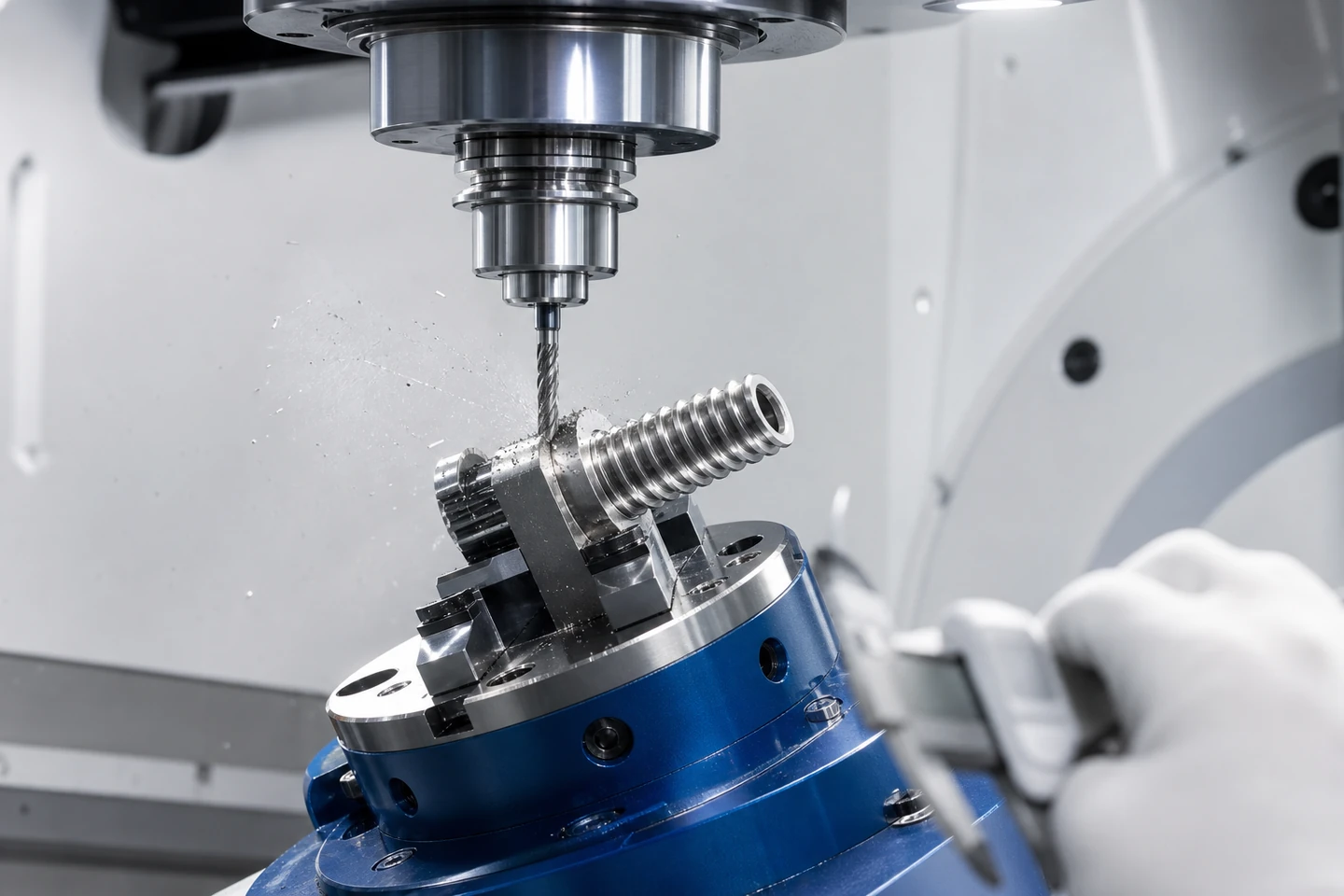
Dedicated ISO 7 cleanroom-adjacent CNC cell for titanium implant work. Carbide tooling life-managed per material, climate-controlled to ±0.5 °C, and a particle count run on every shift coupon.

A 5-axis CNC machining centre cutting a titanium implant in a cleanroom-adjacent cell
In the field

A spinal-cage startup got a 510(k) cleared in 11 months.

A composite of recent programs, anonymised to protect customer IP. Numbers are real ranges from the engagements they’re drawn from.

Inside a recent program · Series-A spinal-implant startup, USA

Collapsed three vendors into one cell, locked the surface-prep stack, and shipped clinical units in 28 days.

The customer was developing an SLM porous-titanium spinal cage with a 510(k) substantial-equivalence path. The prior vendor stack split SLM + HIP + finish-machine + sterilization across four suppliers; sterilization validation kept failing on residual particulates.

We brought SLM, HIP, finish-CNC, and surface prep into a single cell. Engineering closed the surface-prep loop in the DFM call — vapour-honed + ultrasonic-bath + passivated, audited by particle count per lot.

Clinical lot shipped on day 28. Sterilization validation passed on first cycle. 510(k) submission was made at month 7; clearance at month 11 — about three months ahead of the customer’s aggressive plan.

Industry · Spinal implantsGeography · USA + SuzhouProcess · SLM Ti, HIP, CNC, surface prepQuantity · 4,800 clinical + commercial units
The coatings moat

Six finishes US medical shops can no longer run.

Environmental + OSHA rulings since 2018 have closed dozens of US-side passivation and PVD lines. Our partner plants still run them. The short list below shows up most on medical-device drawings.

Stainless implant prep

Sulfochromate passivation

Hex-Cr passivation still spec'd by some legacy implant standards on 316L and 17-4 PH stainless. Closed-loop bay, per-lot ICP audit.

Osseointegration coating

Plasma-spray HAp on Ti

Hydroxyapatite plasma-spray on titanium spinal cages, dental implants, hip stems. Strict EU MDR notified-body audit chain.

Cleanroom surface prep

Electropolish (stainless / Ti)

Closed-loop electropolish on stainless instruments and titanium implants. Ra ≤ 0.1 µm; particle count per lot.

Surgical-instrument wear

PVD TiN / TiCN

PVD hard coatings on cutting edges, drill bits, burrs. Drop-in for hardened-steel inserts where geometry forbids them.

Instrument articulating wear

DLC (diamond-like carbon)

DLC on articulating instrument joints — 60+ Rockwell C with low friction, biocompatible.

ECG / EEG / biosensor contact

Selective gold plate

Selective 24 k gold plating on biopotential electrodes and sensor contacts. Closed-loop cyanide-bath process.

Frequently asked

The questions medical teams keep asking us.

  • ISO 13485 is held by the partner cells we deploy through; 21 CFR 820 readiness audited per program. We can ship DHF-grade traceability with the parts, and support your supplier-audit calendar.

  • Yes. Engineering build → clinical lot → sterilization validation → DHF closure all live in one program. We support comparator benchmark testing for substantial-equivalence packs.

  • Yes — SLM Ti-6Al-4V ELI with HIP is one of our highest-volume medical processes. Porous lattices to 60 – 75 % open volume, surgically-prepped surface roughness.

  • Resin material certs are pulled per heat lot; we run a parallel biocompatibility coupon per lot if your DHF demands it. PEEK, PSU, PEI, PC, silicone all from validated suppliers.

  • Cleanroom assembly + double-pouching in ISO 7 (cleanroom passport per lot). Sterilization through partner ISO 11137 (gamma) and ISO 11135 (EtO) houses; full ISO 17665 (steam) inside our partner cells.

  • For programs over $500 k, yes — embedded ME / RA engineer for the duration of clinical trial. Two customers currently on this model as of 2026.

Ship the lot, close the DHF.

Send drawings, or send an intended-use statement + sterilisation envelope. Either way you’ll have an ME reviewing within 48 hours and a real quote on a real schedule shortly after.

Medical Devices — FabDigit | FabDigit