FabDigit
Space & Aviation

Built for vacuum. Tested in atmosphere. Flown once.

Bracketry, propellant-line hardware, cryogenic flanges, avionics housings, and antenna-feed components for satellites, launchers, and aerospace platforms. From a single qualification build to a small-batch flight lot — held to your outgassing, thermal, and radiation envelope.

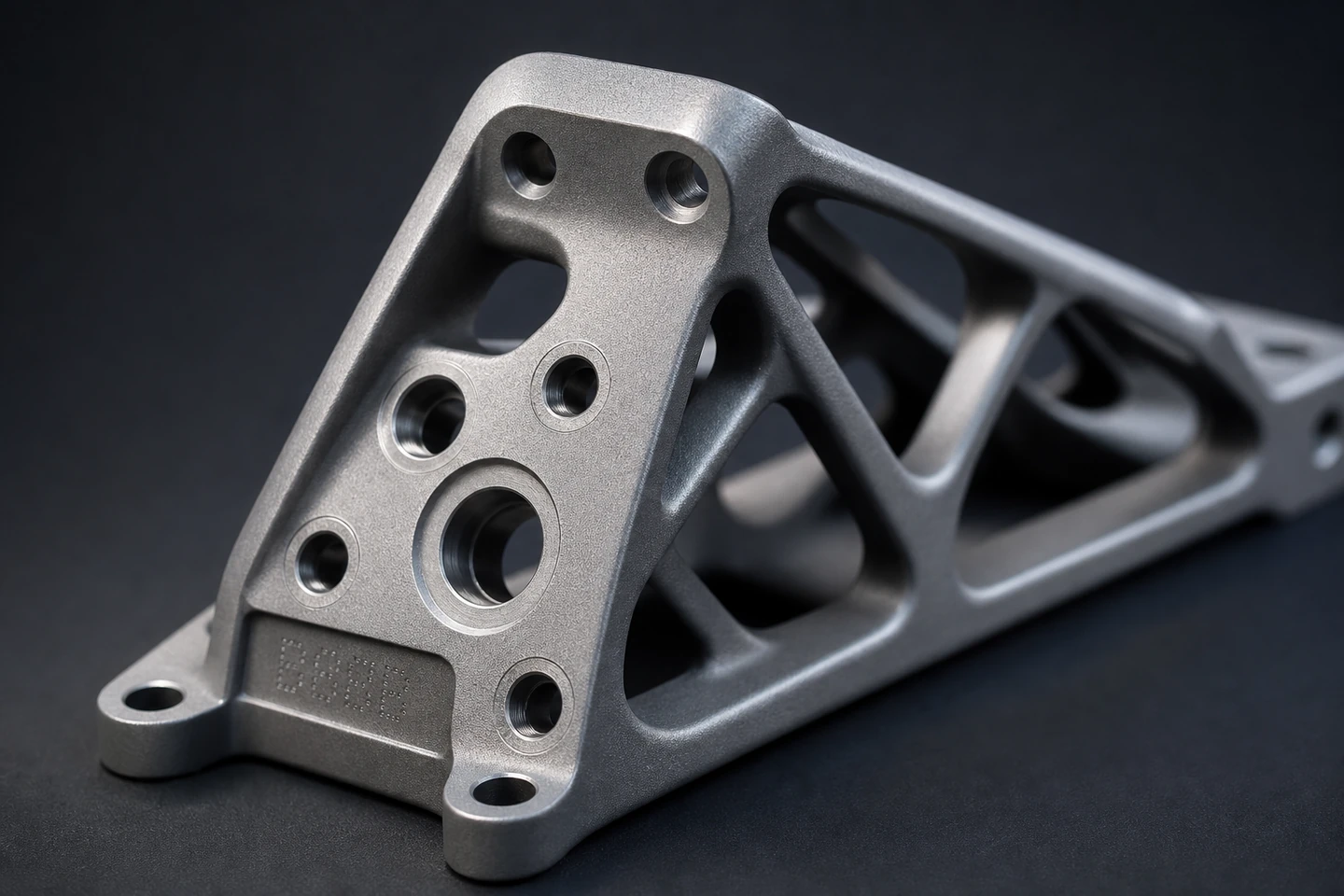
Topology-optimised titanium aerospace bracket on a charcoal-grey backdrop
What makes this hard

Three engineering realities every space program eventually meets.

Flying hardware fails in ways that ground hardware doesn’t. Outgassing, thermal cycling, and radiation budgets compound; the parts that survive flight are the ones designed against all three at once, not in sequence.

Outgassing is a material problem, not a coating problem.

A 1 % TML adhesive on a satellite is a 100 % program risk once it plates your camera lens. We build with ASTM E595 ≤1.0 % TML / ≤0.1 % CVCM materials from CAD onwards — no last-minute substitution.
Thermal cycling kills assemblies, not parts.

−180 °C to +120 °C ten times per day on a LEO spacecraft turns every CTE mismatch into a fatigue crack. Bracket geometry, fastener preload, and bonding-zone surface prep all live in the same fight.

TID and SEE are part of the BoM.

Total ionising dose and single-event effects rule which PCBs you can fly and which materials degrade. We build to MIL-PRF-38535 / ESCC-class supply chains and document every lot.

Capability envelope

What we typically ship — and where the space moat sits.

Working ranges across recent satellite, launcher, and aerospace programs. Coatings row carries our moat: surface treatments restricted on US/EU plating lines that our partner cells still run.

Mechanical tolerance
On flight brackets and propellant-line flanges.
±0.025 → ±0.005 mm
Qualification build lead time
CAD-frozen → flight-coupon parts in hand.
35 – 70 days
Flight lot size
Engineering + qual + flight per platform.
1 – 60 flight pieces
Constellation-scale build
Per-month sustained for small-sat constellations.
50 – 200 ship-sets / month
Outgassing (ASTM E595)
Total mass loss after 24 hr at 125 °C.
0.2 – 0.8 % TML
CVCM ≤ 0.1 % standard
Coatings & finishes
Plating, anodise, and conversion finishes used routinely on flight hardware. Restricted-elsewhere lines marked with a flag.
Black sulfuric anodize, dyed (MLI)Chromic anodize Type IUSChemical conversion (Alodine 1200)USElectroless nickel + boronHard-gold plate (Au 0.5 – 2 µm)Vapour-blast titaniumMLI-grade Kapton coatingVespel SP-1 bushingsWhite paint (Z-93, S13G/LO)Selective silver plate, RF feed
A reference build

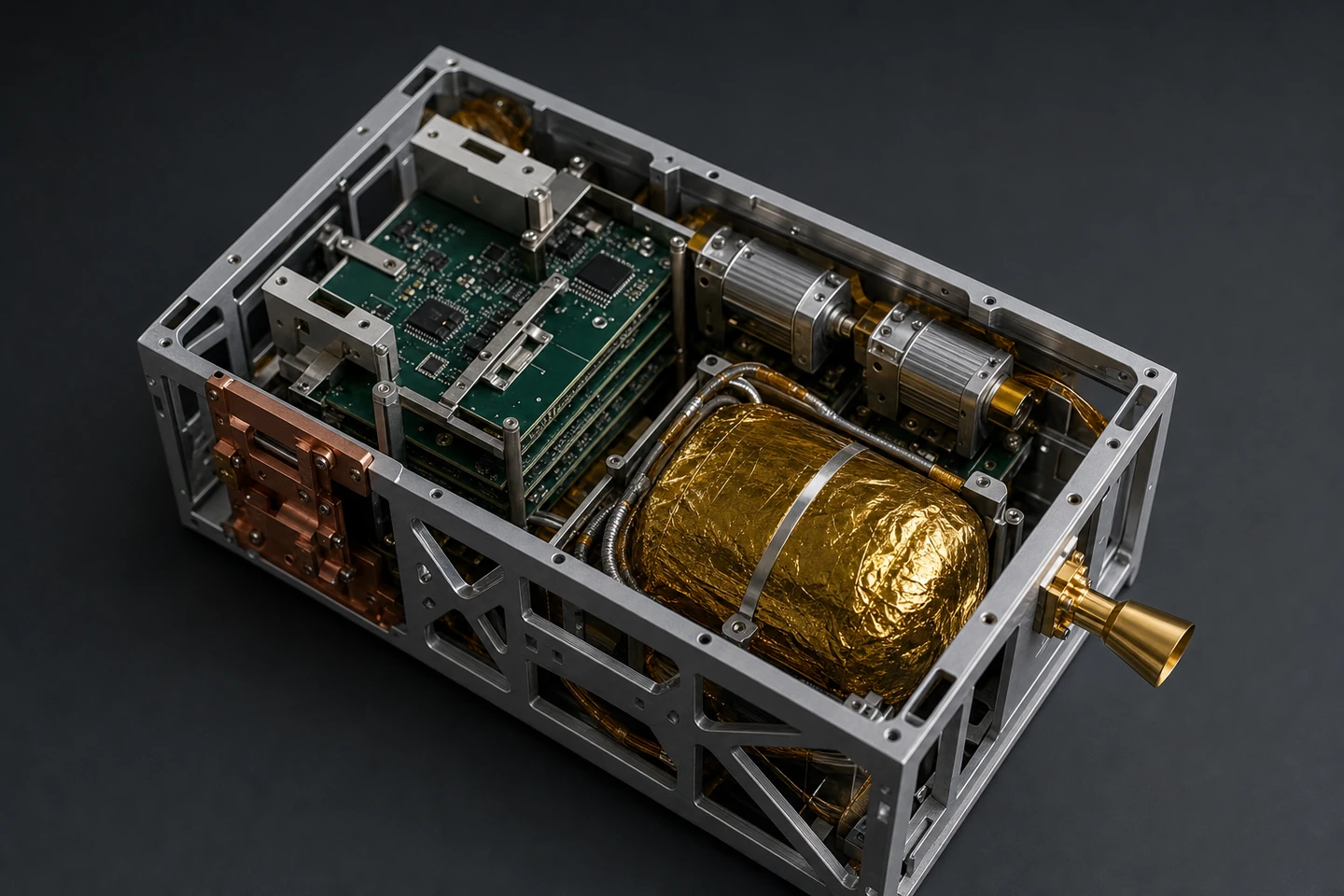
Anatomy of a 6U cubesat chassis, decomposed.

A composite of the small-sat programs we currently build for. 6U class, monopropellant propulsion, S-band TT&C. Each callout is where the engineering trade-off lives.

6U cubesat chassis open, exposing avionics, propellant tank, and reaction wheels
01 · Solar hinge
02 · Avionics stack
03 · Propellant tank
04 · Reaction wheels
05 · Thruster nozzle
06 · Chassis frame
  1. 01

    1 · Copper solar-panel hinge bracket

    Copper-tungsten / Cu-Cr hinge with selective gold plate at the rotation contact. ASTM E595-clean Vespel SP-1 bushing.

  2. 02

    2 · PC/104 avionics stack

    High-rel 8 – 12 layer PCBs, polyimide substrates, conformal-coated, X-ray on every BGA. IPC J-STD-001ES assembly traceability.

  3. 03

    3 · MLI-wrapped propellant tank

    Spun-formed titanium tank with vapour-blast finish under MLI. Helium-leak tested to 10⁻⁹ mbar·L/s.

  4. 04

    4 · Finned aluminum reaction wheels

    Hard-anodised 7075-T6 wheel housings, dynamically balanced to ISO 1940 G1.0. Sealed for cleanroom integration.

  5. 05

    5 · Inconel 718 thruster nozzle

    3D-printed and HIP-treated Inconel 718, finish-machined throat to ±0.01 mm. Acoustic and hot-fire qualified at our partner cell.

  6. 06

    6 · Bead-blasted aluminum frame

    Topology-optimised 6082-T6 frame, vapour-blast finish (no Cr⁶⁺ conversion), bonded-in dielectric stand-offs.

Parts we ship most

Six part archetypes that drive a space / aerospace BoM.

These six parts make up the majority of the spend on a typical satellite or aerospace program. Spec ranges below are working envelopes — your drawing tightens them.

Topology bracket

Topology-optimised Ti-6Al-4V or AlSi10Mg bracket. 5-axis CNC for small lots, SLM + HIP for production lattice fills.

Material
Ti-6Al-4V · AlSi10Mg
Process
5-axis CNC + SLM
Tolerance
±0.025 mm
Run size
1 – 200 pcs

Avionics housing

5-sided machined or sheet-metal avionics enclosures. EMI gasketing, chassis-grounded, MLI-compatible mounting surfaces.

Material
6082-T6 · Mg AZ31
Process
5-axis CNC + sheet
Tolerance
±0.05 mm
Run size
1 – 100 pcs

Propellant line + flange

Welded Ti or Inconel propellant lines, machined flanges with all-metal seals. Helium-trace tested per joint.

Material
Ti-6Al-4V · Inconel 718
Process
CNC + orbital weld
Tolerance
±0.025 mm
Run size
1 – 50 pcs

Cryogenic flange

Machined Ti or austenitic stainless flanges for LOX / LH₂ service. CGA-class sealing surface finish, helium-trace certified.

Material
Ti-6Al-4V · 316L
Process
CNC + grinding
Tolerance
±0.01 mm
Run size
1 – 50 pcs

Antenna feed

Machined or printed aluminum / brass antenna feedhorns and waveguides. Selective gold plating at the RF surface.

Material
6082-T6 · brass
Process
5-axis CNC + plate
Tolerance
±0.005 mm
Run size
1 – 100 pcs

Cubesat chassis

Full cubesat / smallsat structural chassis. Modular rail system, bead-blast finish, bonded-in fasteners.

Material
6082-T6 / 7075-T6
Process
5-axis CNC
Tolerance
±0.05 mm
Run size
1 – 60 ship-sets
The decision tree

Pick a flight envelope.
The material library lights up.

Every space program lives or dies on the thermal, outgassing, and radiation envelope. Pick an envelope to see which materials qualify, which sit on margin, and which fail outright — and what FabDigit ships for that envelope.

Material library
PASSMARGINFAIL
6082-T6
7075-T6
ABS
AlSi10Mg SLM
Brass
GF-PA66
Inconel 718
Magnesium AZ31
PEEK
PEKK
POM/Acetal
PVC
Polyimide PCB
Stainless 316L
Ti-6Al-4V
Vespel SP-1
Vespel SP-3
Engineering data

Three questions space teams eventually ask.

Industry-typical ranges from recent engagements. Specific commitments land in your quote.

Chart · Cost vs volume

Cost-per-bracket by process and volume

At engineering-model quantities, 5-axis CNC wins on speed and revisability. SLM + HIP wins at qual-coupon volumes when the lattice geometry pays back. Pure conventional cast loses past 5 brackets.

$0$200$400$600$800$1000$1200$1400$1600$1800$2000$2200$2400$2600$2800$3000$3200$34001101001kquantity (pcs) · log scaleCast ≈ CNC @ ~200 pcs
5-axis CNCSLM Ti-6Al-4V + HIPInvestment cast + finish
Chart · Material profile

Bracket material trade-offs

Three candidate flight materials. Titanium wins on strength + thermal compatibility; AlSi10Mg SLM wins on lattice fill; Mg AZ31 saves mass when the loads allow it.

Stiffness / weighthigher = betterMachinability0–1Outgassing (inv.)lower = betterCTE match0–1Cost (inv.)lower = betterAM lattice fill0–1
Ti-6Al-4VAlSi10Mg SLMMg AZ31
Chart · Build timeline

A 70-day flight-lot schedule

Freeze-to-ship-set for a 6U cubesat structural lot. Parallel where it can be, never serial when it doesn't have to be — qualification coupons run alongside flight builds.

d0d14d28d42d56d70DFM + materials review4dStock procurement (Ti, Al)10dSLM coupons + HIP14d5-axis fixtures + programs10dCNC bracket cell run18dVapour-blast + clean10dCleanroom assembly14dHelium-leak + outgassing QC12dGEVS pre-coupons10dShip-set #1 sign-off6d
Program lifecycle

How a flight program moves from CAD to qualification.

Space programs are notorious for compressed schedules right before qualification. The six phases below are how we keep one moving without leaving any test campaign incomplete.

Phase 01

CAD intake & material review

Drawings + STEP + outgassing/thermal envelope land in our portal. A mechanical + materials engineer review them within 48 hours, flagging material substitutions and surface-prep choices before quote.

Phase 02

Quote + engineering-model parts

Quote out in 5 – 7 days. First engineering-model parts on a 5-axis fixture within 10 days; first ship-set in hand within 35 – 70 days.

Phase 03

Qualification-coupon ship + CMM

CMM, ASTM E595 coupon, helium-trace leak data, surface roughness reports — all packaged with the parts. We don’t self-certify; we ship evidence your DER will recognise.

Phase 04

GEVS / thermal-vac support

On-site or remote support during vibration, thermal-vac, and TID qualification. ECNs flow through engineering, not through silent change orders on the next lot.

Phase 05

Flight lot build + traceability

Heat-lot traceability per part, IPC J-STD-001ES on the PCBs, cleanroom final assembly + sealing. Each lot ships with its DPL pack.

Phase 06

Constellation ramp + spares

50 – 200 ship-sets / month for small-sat constellations, with held-inventory spares per ship-set. Long-lead lots committed 24 months forward.

Inside the cell

Where titanium becomes a flight bracket.

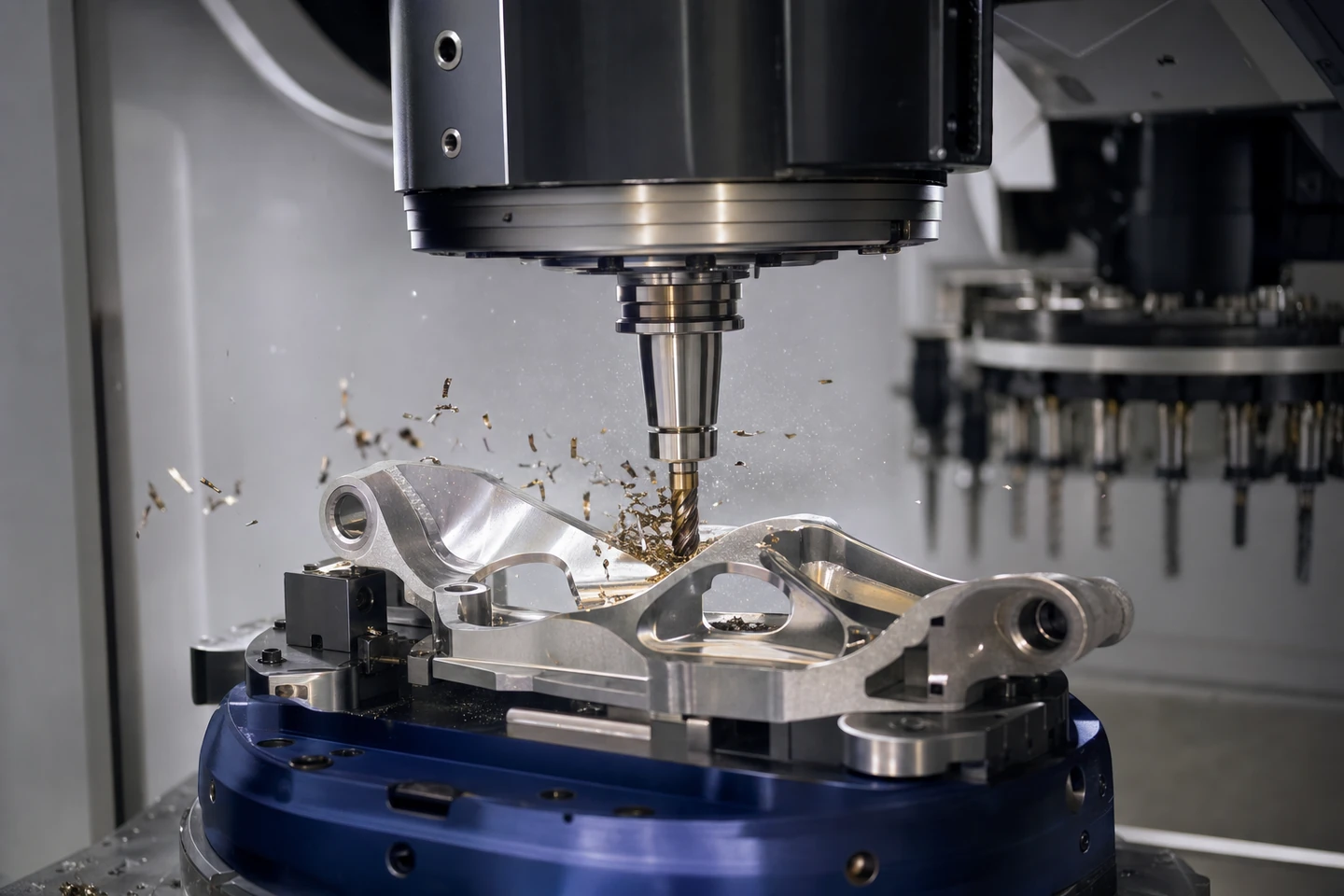
Dedicated aerospace 5-axis CNC cell for titanium and Inconel work. Tool-life-managed cutters per material, climate-controlled to ±0.5 °C, and a coupon CMM in-line so the second pass on a long part never drifts.

A 5-axis CNC machining centre cutting a titanium aerospace bracket
In the field

A LEO constellation hit ship-set #1 in 42 days.

A composite of recent programs, anonymised to protect customer IP. Numbers are real ranges from the engagements they’re drawn from.

Inside a recent program · Series-B Earth-observation constellation, Europe

Cut ship-set #1 from 4 months to 42 days by collapsing six vendors into one cell.

The customer was scaling from 1-off engineering models to a 28-spacecraft LEO constellation, on a launch window that didn’t move. Their previous vendor stack quoted 4 months from drawing freeze to first ship-set; the launch slot wouldn’t wait.

We took the entire BoM into a single cell: 5-axis Ti brackets, SLM AlSi10Mg primary structure, polyimide PCBA, MLI-spec sheet metal, and the propellant-line flanges. Engineering ran a parallel SLM proto while the conventional CNC schedule ramped — the moment the SLM coupons passed outgassing, the design froze.

Ship-set #1 landed in 42 days; ship-sets #2 through #28 followed at one every 5 days. Constellation launched on time with two ship-sets in reserve.

Industry · LEO Earth observationGeography · Europe + ShenzhenProcess · 5-axis CNC, SLM, PCBA, sheetQuantity · 30 ship-sets + spares
The coatings moat

Six finishes US space shops can no longer run.

EPA / OSHA rulings since 2018 have closed dozens of US-side aerospace conversion lines. Our partner plants still run them daily. The list below shows up most on flight drawings.

Aerospace conversion legacy

Chromic anodize Type I

Hex-Cr anodise still spec'd by some legacy aerospace standards on aluminum brackets. Closed-loop bay, full neutralisation, per-lot conductivity audit.

Conductive ground-path on Al

Alodine 1200 (Cr⁶⁺ conversion)

Conductive corrosion protection on aluminum chassis grounded to spacecraft chassis. Audited per lot for thickness uniformity.

MLI-mating low-α surface

Black sulfuric anodize Type II, dyed

Low-α MLI-mating finish for sun-side panels. Dyed black to within IR spec, no chromium.

RF feed + contact

Selective hard-gold plate

Selective hard-gold 0.5 – 2 µm on antenna feedhorns, waveguides, slip-ring contacts. Cyanide-bath line; closed-loop water recovery.

Outgassing-clean finish

Vapour-blast titanium

Vapour-blast finish on titanium brackets and tanks — no chemical residue, ASTM E595-clean.

Solar-side α/ε control

White paint (Z-93, S13G/LO)

Low-α/ε white paint applied in a cleanroom paint booth, per-batch coupons for spectroradiometric validation.

Frequently asked

The questions space teams keep asking us.

  • AS9100 compliance is held by the partner cells we deploy through. A US onshore cell handles ITAR / export-controlled flight programs. NDA before any CAD changes hands; site audits with 7 days notice.

  • We build to ASTM E595 by material choice from CAD onwards, and submit coupons for E595 testing where the program demands it. Adhesives, bonding materials, and bushings are all chosen against ≤1.0 % TML / ≤0.1 % CVCM unless otherwise specified.

  • Yes — Ti-6Al-4V SLM is one of our most-used aerospace processes. HIP is in-line for fatigue-critical parts. We can hand off raw or finish-machined to ±0.01 mm.

  • We run a dedicated bead-blast + vapour-blast cell for MLI-mating surfaces — no chromate, no waxed-paper residue. Roughness and outgassing coupons ship with each lot.

  • For programs over $500 k we send a mechanical engineer on-site for GEVS vibration and thermal-vac campaigns. We can also run pre-qual coupons through our own thermal-vac partner.

  • Yes — ISO 8 final clean is the default; ISO 6 or ISO 7 for optical and sensitive-payload programs. Cleanroom passport with each ship-set.

Ship the flight lot, not the apology.

Send drawings, or send a thermal-vac envelope and an outgassing budget. Either way you’ll have an ME reviewing within 48 hours and a real quote on a real schedule shortly after.

Space & Aviation — FabDigit | FabDigit