
Formlabs Nylon 12 White Powder (PA12, SLS)
Formlabs · SLS powder
A white, dyeable PA12 powder for high-contrast prototypes, medical models, and customer-facing end-use parts.
Formlabs datasheet values, printed parts
Other PA12 grades and fills
Compare the PA12 products and conditions in the library; see the grade overview at PA12.
- HP PA 12 GB
- Farsoon FS3300PA-F
- Formlabs Nylon 12 GF
- Sinterit PA12 Smooth
- FR
- ESD
- Formlabs Nylon 12 Tough
- Evonik INFINAM PA 12 (VESTOSINT)
- Farsoon FS3401GB
- HP PA 12 S
- AL
- HP PA 12 FR
- Farsoon FS3300PA
- EOS PA 2210 FR
- Formlabs Nylon 12 White
- EOS Alumide
- HP PA 12
- EOS PA 2200
- EOS PA 2201
- EOS PA 2220 HighReuse
- EOS PA 2200 CarbonReduced
- ALM PA 640-GSL
- HP PA 12 W
- EOS PrimePart FR (PA 2241 FR)
- Formlabs Nylon 12
- EOS PA 3200 GF
- CF
Compare all 27 grades and fillsHide
| Grade · open for datasheet | Best for | Yield MPa | Tensile MPa | Elong. % | Hardness |
|---|---|---|---|---|---|
HP 3D High Reusability PA 12 GB · MJF powder | A 40% glass-bead-filled PA 12 for stiff, dimensionally stable parts with fine detail and repeatability. | — | 29 | 10 | — |
SLS powder | — | — | 36 | 5 | — |
Formlabs Nylon 12 GF Powder · SLS powder | A glass-filled PA12 powder for rigid, dimensionally stable parts under sustained loading and elevated temperatures. | — | 38 | 4 | — |
SLS powder | — | — | 38 | 4.6 | 76 Shore D |
Flame-retardant PA12 | Use for aircraft interiors, rail and electrical enclosures where V-0 / FAR 25.853 burn compliance is mandatory; slightly lower toughness. | 40 | 44 | 6 | 78 Shore D |
Electrically conductive / static-dissipative PA12 | Choose for electronics handling trays, fixtures and fuel-system parts needing controlled surface resistivity (10⁶–10⁹ Ω). | 41 | 45 | 7 | 78 Shore D |
Formlabs Nylon 12 Tough Powder · SLS powder | A ductile PA12 powder for accurate, impact-resistant parts with reduced warpage and economical powder reuse. | — | 42 | 25 | — |
SLS powder | — | 43 | 49 | 311 | 75 Shore D |
SLS powder | — | — | 44 | 9.3 | — |
HP 3D High Reusability PA 12 S (enabled by Arkema) · MJF powder | A high-reuse PA 12 grade for smooth surfaces, fine detail, and cost-efficient aesthetic production parts. | — | 45 | 12 | — |
Aluminium-filled PA12 | Metallic-look, stiff, easily tumbled/polished parts for tooling aids and design models; better heat conduction, low elongation. | — | 46 | 4 | 80 Shore D |
HP 3D High Reusability PA 12 FR (enabled by Evonik) · MJF powder | A halogen-free flame-retardant PA 12 with a smooth finish for safety-critical housings and production components. | — | 46 | 4.7 | — |
SLS powder | — | — | 46 | 36 | — |
SLS powder | — | — | 46 | 4 | — |
Formlabs Nylon 12 WhiteThis page Formlabs Nylon 12 White Powder · SLS powder | A white, dyeable PA12 powder for high-contrast prototypes, medical models, and customer-facing end-use parts. | — | 47 | 8 | — |
SLS powder | — | — | 48 | 4 | 76 Shore D |
HP 3D High Reusability PA 12 (enabled by Evonik) · MJF powder | HP's flagship MJF nylon balances strength, ductility, detail, and powder efficiency for functional production parts. | — | 48 | 20 | — |
SLS powder | — | — | 48 | 18 | 75 Shore D |
SLS powder | — | — | 48 | 15 | 75 Shore D |
SLS powder | — | — | 48 | 10 | — |
SLS powder | — | — | 48 | 18 | — |
SLS powder | — | — | 49 | 3 | — |
HP 3D High Reusability PA 12 W · MJF powder | A white engineering PA 12 for strong functional parts that can remain white or take vibrant color finishes. | — | 49 | 17 | — |
SLS powder | — | — | 49 | 15 | — |
Formlabs Nylon 12 Powder · SLS powder | A versatile, biocompatible PA12 powder for dimensionally accurate functional prototypes and durable end-use parts. | — | 50 | 11 | — |
SLS powder | — | — | 51 | 9 | 80 Shore D |
Carbon-fibre reinforced PA12 | Highest stiffness-to-weight powder-bed nylon — for lightweight brackets, drone and motorsport parts; strongly anisotropic and brittle. | — | 72 | 4 | 83 Shore D |
What is Formlabs Nylon 12 White Powder?
Formlabs Nylon 12 White Powder is Formlabs' PA12 powder for Selective Laser Sintering on Fuse 1+ 30W — a white, dyeable PA12 powder for high-contrast prototypes, medical models, and customer-facing end-use parts. Formlabs Nylon 12 White Powder has a tensile strength of 47 MPa (6.82 ksi), stronger than 50% of polymer grades. Elongation at break is 8% and the elastic modulus is 1.95 GPa (0.283 Msi). Pick Formlabs in the Powder row when quoting PA12 and the part is printed from this powder.
Limitations
- Higher moisture uptake — 1.4%, worse than 90% of polymer grades
About this powder
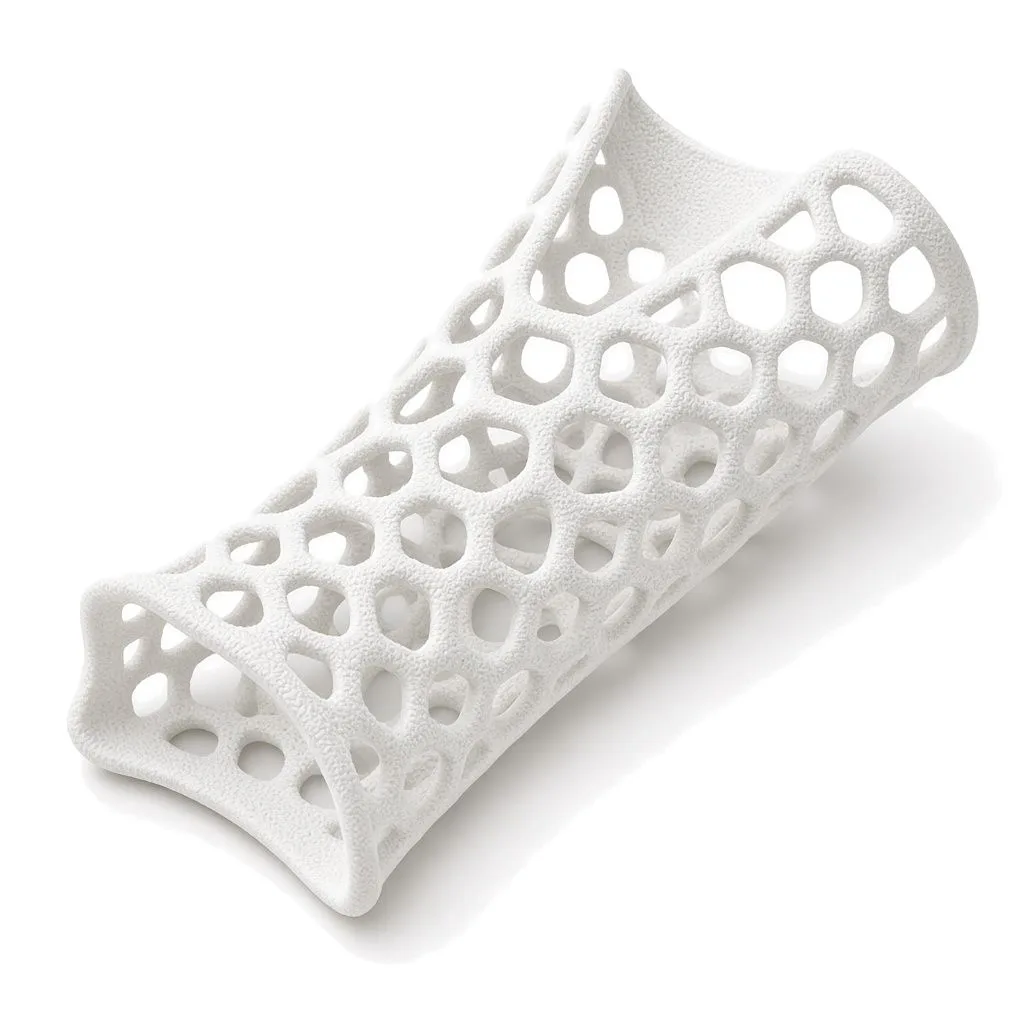
“Nylon 12 White Powder combines all of the great qualities of general purpose, biocompatible Nylon 12 Powder with the customizability of white parts. Create medical devices, models with high contrast and detail, or functional prototypes that can be easily dyed to suit specific applications.” — Formlabs, product description
- Manufacturer
- Formlabs
- Product
- Nylon 12 White Powder
- Base polymer
- PA12
- Process
- Selective Laser Sintering (SLS)
- Printers
- Fuse 1+ 30W
- As-printed colour
- White — Prints white; finish and colour closer to MJF parts than traditional SLS; dyeing options depend on the base colour and grade
- Build envelope
- 165 × 165 × 300 mm. Usable part size depends on orientation, spacing and process allowances.
- Build atmosphere
- Inert atmosphere specified; confirm the gas and settings for the printer/material profile.
- Powder refresh
- 30 % fresh powder in the recorded recipe. Follow the manufacturer’s build and powder-management conditions.
- Formlabs categories
- General Purpose · Impact Resistant · High Stiffness · Temperature Resistant · Medical
- Reported material classifications
- Skin Contact · Mucosal Membrane Contact · ISO 10993-5 · ISO 10993-10 · ISO 10993-11 · ISO 10993-23 · UL 94 HB. Scope and test conditions apply; these do not certify the finished part or assembly.
- Manufacturer data source
- Formlabs source reference (Rev 01 2024-08-10)
- FabDigit material reference
- Download reference PDF — FabDigit layout with Formlabs data and source attribution.
- Ordering
- Select it in the Powder row when quoting PA12. The quote confirms the selected material and process.
Formlabs positions it for manufacturing aids, end-use parts, rapid prototyping, medical devices and models and customer-facing parts dyed to brand colours.
Choosing Nylon 12 White Powder
White SLS PA12 for detailed, customer-facing parts that need a clean base colour or a controlled dyeing step.
- Consider it for
- High-contrast medical models and guides · Branded prototypes and low-volume housings · Fixtures where marks and surface damage should be easy to see
- Tradeoffs
- It is less ductile than Nylon 12 Tough, and Formlabs recommends nitrogen when colour consistency matters because printing in air can yellow reused powder. Published biocompatibility tests do not qualify a finished device.
- Design and validation
- Use the Fuse 1+ 30W process basis, preserve the published X/Y-versus-Z distinction for loaded features, and plan the required powder-aging and bed-temperature setup before production.
- Finishing
- White is the as-printed colour. Dyeing can add colour as a separate post-process, but the requested colour and application compatibility still need confirmation; blasting or tumbling can also change edge definition and surface texture.
- Before choosing
- Is a white or vividly dyed appearance more important than maximum ductility? Can the production workflow maintain the recommended nitrogen atmosphere?
Selection notes based on Formlabs Nylon 12 White Powder product page · Formlabs Nylon 12 White Powder TDS, Rev 01. Published test results depend on the stated printer, orientation and conditioning. Compare material families · Choose a finishing route.
Formlabs Nylon 12 White Powder properties
Typical values for Formlabs Nylon 12 White Powder (Rev 01 2024-08-10); review each property’s test condition. Only this product’s reported properties are shown; unreported properties are omitted. Bars are the position among polymer grades.
Mechanical6
Formlabs Nylon 12 White Powder has a tensile strength of 47 MPa (6.82 ksi), stronger than 50% of polymer grades. Elongation at break is 8% and the elastic modulus is 1.95 GPa (0.283 Msi).
per ASTM D638-14 Type 1
per ASTM D638-14 Type 1
per ASTM D638-14 Type 1; X/Y 8 / Z 6
per ASTM D790-17
per ASTM D790-17
per ASTM D256-10
Thermal4
per ASTM D648-16
per ASTM D648-16
per ASTM D1525
3.00 mm
Physical1
per ASTM D570; printed part
Use published values for design screening. Confirm the grade, build direction, conditioning and available lot documentation when quoting.
Test basis and additional results
Read the values with the specimen preparation and test conditions that produced them.
- Manufacturer document
- 2401996-TDS-ENUS-0 · Rev 01 · 2024-08-10
- Specimen preparation
- Fuse 1+ 30W on a bed-temperature-tuned printer; specimens conditioned at 23 °C and 50% relative humidity for 40 hours.
- Build direction
- Elongation is reported separately for X/Y (8%) and Z (6%). The other table values do not state an orientation.
The reviewed reference copy retains manufacturer document ID 2401996; the current live official PDF uses a descriptive filename.
Solvent compatibility screen
24 h immersion mass change reported by the manufacturer
| Solvent | 24 h weight gain |
|---|---|
| Acetic acid 5% | 0.2% |
| Acetone | 0.2% |
| Bleach (~5% NaOCl) | 0.2% |
| Butyl acetate | 0.2% |
| Diesel fuel | 1.3% |
| Diethyl glycol monomethyl ether | 1.0% |
| Hydraulic oil | 1.7% |
| Hydrogen peroxide (3%) | 0.1% |
| Isooctane | 0.3% |
| Isopropyl alcohol | 0.2% |
| Mineral oil (heavy) | 2.2% |
| Mineral oil (light) | 2.0% |
| Salt water (3.5% NaCl) | 0.1% |
| Skydrol 5 | 1.9% |
| Sodium hydroxide solution (0.025%, pH 10) | 0.1% |
| Strong acid (concentrated HCl) | 4.8% |
| TPM | 1.1% |
| Water | 0.1% |
| Xylene | 0.2% |
TDS test article: printed 1 × 1 × 1 cm cube. Weight change alone does not establish sealing, retained strength, or long-term chemical life.
Biocompatibility endpoint results
ISO 10993 endpoints listed in the manufacturer TDS
| Standard / endpoint | Result |
|---|---|
| ISO 10993-11:2017 — systemic toxicity | No systemic toxicity |
| ISO 10993-5:2009 | Not cytotoxic |
| ISO 10993-23:2021 | Not an irritant |
| ISO 10993-10:2021 | Not a sensitizer |
| ISO 10993-11:2017 — pyrogenicity | Nonpyrogenic |
Manufacturer material-sample result. It does not qualify a finished part or device for its intended use.
How to interpret this data
The original formulation document keeps its manufacturer document ID even when the current live official PDF uses a different filename.
The TDS says properties may vary with part geometry, print orientation, and temperature.
The ASTM D570 water-absorption row does not state a 24-hour duration.
The TDS recommends inert atmospheric control for best results; current Formlabs guidance describes nitrogen as recommended rather than physically mandatory.
Formlabs Nylon 12 White Powder — frequently asked
What is Formlabs Nylon 12 White Powder used for?
White SLS PA12 for detailed, customer-facing parts that need a clean base colour or a controlled dyeing step. Consider it for high-contrast medical models and guides, branded prototypes and low-volume housings and fixtures where marks and surface damage should be easy to see. It is less ductile than Nylon 12 Tough, and Formlabs recommends nitrogen when colour consistency matters because printing in air can yellow reused powder. Published biocompatibility tests do not qualify a finished device.
What should I validate before using Formlabs Nylon 12 White Powder?
Use the Fuse 1+ 30W process basis, preserve the published X/Y-versus-Z distinction for loaded features, and plan the required powder-aging and bed-temperature setup before production. Is a white or vividly dyed appearance more important than maximum ductility? Can the production workflow maintain the recommended nitrogen atmosphere?
How can Formlabs Nylon 12 White Powder be finished?
White is the as-printed colour. Dyeing can add colour as a separate post-process, but the requested colour and application compatibility still need confirmation; blasting or tumbling can also change edge definition and surface texture.
How should I interpret the published values for Formlabs Nylon 12 White Powder?
Fuse 1+ 30W on a bed-temperature-tuned printer; specimens conditioned at 23 °C and 50% relative humidity for 40 hours. Elongation is reported separately for X/Y (8%) and Z (6%). The other table values do not state an orientation. Read each value with the stated method, specimen preparation and conditioning.
Sources
Product values come from the selected manufacturer source and are normalised for comparison. Confirm the quoted process, build direction, conditioning and available lot documentation for the finished part.