
Formlabs TPU 90A Powder (TPU, SLS)
Formlabs · SLS powder
A tough, skin-safe TPU elastomer for flexible parts requiring high elongation, tear resistance, and everyday durability.
Formlabs datasheet values, printed parts
Other TPU grades and fills
Compare the TPU products and conditions in the library; see the grade overview at TPU.
- Sinterit Flexa Gray
- EOS TPU 1301
- Formlabs TPU 90A
- Forward AM Ultrasint TPU01
- Sinterit Flexa Bright
- Lubrizol ESTANE 3D TPU M88A
- Lubrizol ESTANE 3D TPU M95A
- Shore D 60
- As Printed
- Shore A 70
- FR V-0
- ESD
- Aliphatic
- Ether
- Shore A 85
- Shore A 60 to Shore D 80
- Ester
- GF20
- Shore A 95
Compare all 19 grades and fillsHide
| Grade · open for datasheet | Best for | Yield MPa | Tensile MPa | Elong. % | Hardness |
|---|---|---|---|---|---|
SLS powder | — | — | 4 | 136 | 70 Shore A |
SLS powder | — | — | 7 | 250 | 86 Shore A |
Formlabs TPU 90AThis page Formlabs TPU 90A Powder · SLS powder | A tough, skin-safe TPU elastomer for flexible parts requiring high elongation, tear resistance, and everyday durability. | — | 9 | 310 | 90 Shore A |
MJF powder | A rubber-like TPU combining elasticity, rebound, fatigue resistance, and shock absorption for durable flexible parts. | — | 9 | 280 | 88 Shore A |
SLS powder | — | — | 10 | 318 | 79 Shore A |
MJF powder | A soft, durable TPU for complex flexible production parts and lattice structures with straightforward cold unpacking. | — | 15 | 440 | 88 Shore A |
MJF powder | A durable polyether TPU with high elasticity, abrasion resistance, energy rebound, and skin-contact suitability. | — | 17 | 400 | 93 Shore A |
Rigid engineering TPU | Choose for stiff snap-fit housings, wheel cores, chain guides and cable strain relief that must still absorb impact at low temperature. | 25 | 55 | 320 | 60 Shore D |
FDM/FFF printed TPU filament (typ. 95A) | Use for printed flexible prototypes, gaskets and shoe midsoles; expect 60–80 % of injection-moulded strength and Z-direction weakness. | — | 28 | 380 | 45 Shore D |
Soft TPU | Pick for soft-touch overmoulds, flexible tubing, bellows and low-durometer seals. | — | 28 | 680 | 70 Shore A |
Halogen-free flame-retardant TPU | Specify for cable jackets, connectors and enclosures needing UL 94 V-0 at 1.5–3 mm; some loss of tear strength and elongation. | — | 28 | 400 | 40 Shore D |
ESD / antistatic conductive TPU | Use for antistatic hoses, conveyor parts and ESD-safe flexible components in electronics handling. | — | 30 | 350 | 42 Shore D |
Aliphatic (HDI/H12MDI) optically clear, non-yellowing TPU | Use for clear films, paint-protection film, safety-glass interlayers and light guides where non-yellowing UV stability is required. | — | 35 | 500 | 35 Shore D |
Polyether-based TPU | Choose for wet, humid or microbe-exposed service and for good low-temperature flexibility; slightly lower abrasion/oil performance than ester. | — | 38 | 600 | 34 Shore D |
Shore A 85Default Medium-soft general purpose TPU | Default all-round hardness for seals, cable jackets, wheels, grips and flexible parts. | — | 40 | 550 | 33 Shore D |
Shore A 60 | Use when the design tolerates any TPU hardness and the exact grade is chosen later by the moulder. | — | 40 | 500 | 40 Shore D |
Polyester-based TPU | Best abrasion, tear, oil and fuel resistance at lowest cost — avoid continuous hot/humid or immersed service (hydrolysis). | — | 45 | 520 | 38 Shore D |
20 % glass-fibre reinforced TPU | Use where a semi-rigid, dimensionally stable structural part with TPU toughness is needed (housings, wheel hubs, sports hardware). | — | 45 | 25 | 70 Shore D |
Hard elastomeric TPU | Pick for load-bearing rollers, couplings, ski boots, hose and abrasion-critical parts needing stiffness with flexibility. | — | 50 | 480 | 45 Shore D |
What is Formlabs TPU 90A Powder?
Formlabs TPU 90A Powder is Formlabs' TPU powder for Selective Laser Sintering on Fuse 1+ 30W, Fuse 1 — a tough, skin-safe TPU elastomer for flexible parts requiring high elongation, tear resistance, and everyday durability. Formlabs TPU 90A Powder has a tensile strength of 8.7 MPa (1.26 ksi), weaker than 79% of polymer grades. Elongation at break is 310%. Formlabs TPU 90A Powder has a density of 1.14 g/cm³ (0.0412 lb/in³), lighter than 60% of polymer grades. Pick Formlabs in the Powder row when quoting TPU and the part is printed from this powder.
Advantages
- Ductile — tolerates forming and impact — 310%, better than 82% of polymer grades
Limitations
- Higher moisture uptake — 0.89%, worse than 81% of polymer grades
About this powder
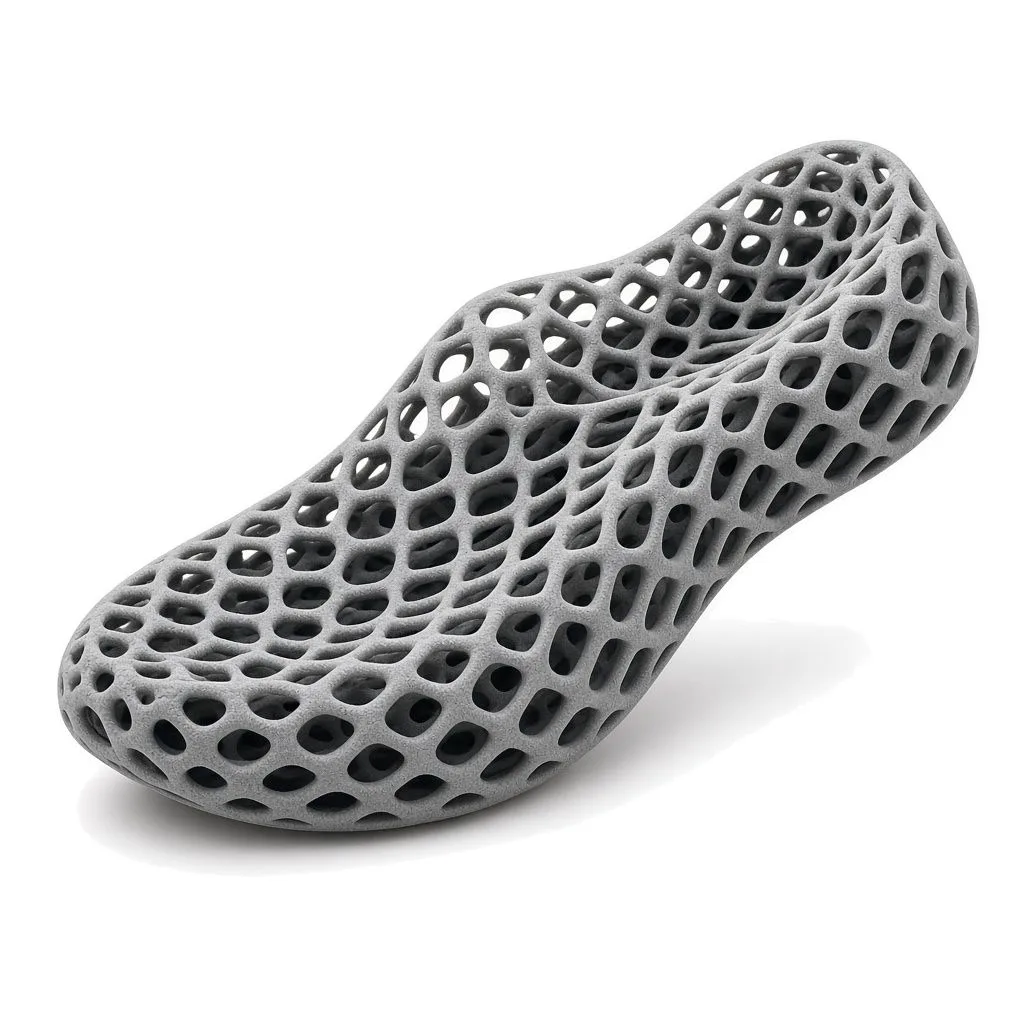
“TPU 90A Powder is a tough elastomer with high elongation at break and superior tear strength for flexible, resilient, and skin-safe prototypes and end-use parts. It is ideal for flexible functional parts that withstand the demands of everyday use.” — Formlabs, product description
- Manufacturer
- Formlabs
- Product
- TPU 90A Powder
- Base polymer
- TPU
- Process
- Selective Laser Sintering (SLS)
- Printers
- Fuse 1+ 30W, Fuse 1
- As-printed colour
- Gray — Formlabs lists the as-printed colour as Grey
- Build envelope
- 165 × 165 × 300 mm. Usable part size depends on orientation, spacing and process allowances.
- Build atmosphere
- No mandatory inert atmosphere recorded; follow the selected printer/material profile.
- Powder refresh
- 20 % fresh powder in the recorded recipe. Follow the manufacturer’s build and powder-management conditions.
- Formlabs categories
- Temperature Resistant · Elastomeric · Medical
- Reported material classifications
- Skin Contact · Mucosal Membrane Contact · ISO 10993-5 · ISO 10993-10 · ISO 10993-23. Scope and test conditions apply; these do not certify the finished part or assembly.
- Manufacturer data source
- Formlabs source reference (Rev 01 2023-03-14)
- FabDigit material reference
- Download reference PDF — FabDigit layout with Formlabs data and source attribution.
- Ordering
- Select it in the Powder row when quoting TPU. The quote confirms the selected material and process.
Formlabs positions it for end-use parts, rapid prototyping, wearables and soft-touch elements, gaskets, seals, masks, belts, plugs, and tubes, padding, dampers, cushions, and grippers, soles, splints, orthotics, and prosthetics and protective sports equipment.
Choosing TPU 90A Powder
A Fuse-series Shore 90A TPU to consider for resilient, flexible SLS parts; geometry determines the response of the finished component.
- Consider it for
- Wearables and protective components · Flexible grips and gaskets · Damping or compliant prototype features
- Tradeoffs
- A Shore 90A elastomer is not a rigid nylon and its performance depends on geometry, wall thickness and orientation. Define the required compression and tear behavior rather than relying on tensile data alone.
- Design and validation
- Prototype lattice and wall sections at the actual force and cycling regime. Review directions and post-processing before fixing a fatigue-critical design.
- Finishing
- Gray is the as-printed colour; a separate finish is required for a different colour. Test surface treatment where grip or skin-contact feel matters.
- Before choosing
- Is 90A the needed hardness, or should an alternative elastomer be screened? Will compression set or tear resistance govern the application?
Selection notes based on Formlabs TPU 90A Powder TDS, Rev 01. Published test results depend on the stated printer, orientation and conditioning. Compare material families · Choose a finishing route.
Formlabs TPU 90A Powder properties
Typical values for Formlabs TPU 90A Powder (Rev 01 2023-03-14); review each property’s test condition. Only this product’s reported properties are shown; unreported properties are omitted. Bars are the position among polymer grades.
Mechanical5
Formlabs TPU 90A Powder has a tensile strength of 8.7 MPa (1.26 ksi), weaker than 79% of polymer grades. Elongation at break is 310%.
per ASTM D412-16 Method A; X/Y 8.7 / Z 7.2
per ASTM D412-16 Method A; X/Y 310 / Z 110
per ASTM D624-00 (2020); X/Y 66 / Z 39
per ASTM D395-18 Method B; 23 °C 20.5 / 70 °C 59.9
per ASTM D2240-15 (2021)
Thermal1
per ASTM D1525
Physical2
Formlabs TPU 90A Powder has a density of 1.14 g/cm³ (0.0412 lb/in³), lighter than 60% of polymer grades.
per ASTM D570; printed part
per In-house method; Bulk density (sintered)
Manufacturability1
per ISO 15512 Method D
Use published values for design screening. Confirm the grade, build direction, conditioning and available lot documentation when quoting.
Test basis and additional results
Read the values with the specimen preparation and test conditions that produced them.
- Manufacturer document
- 2301750-TDS-ENUS-0 · Rev 01 · 2023-03-14
- Specimen preparation
- The TDS says Fuse 1 and Fuse 1+ 30W results are equivalent within experimental uncertainty; it does not state a specimen-conditioning regime.
- Build direction
- Tensile strength, elongation, stress at 50% and 100% elongation, and tear resistance report X/Y and Z values. The remaining rows do not state an orientation.
The reviewed reference copy contains the same checked data as the live official TDS, with the solvent table paginated separately.
Additional elastomer observations
Manufacturer TDS methods listed by row
| Observation | Metric | Imperial | Method |
|---|---|---|---|
| Stress at 50% elongation (X/Y) | 6.1 MPa | 889 psi | ASTM D412-16, Method A |
| Stress at 50% elongation (Z) | 5.9 MPa | 860 psi | ASTM D412-16, Method A |
| Stress at 100% elongation (X/Y) | 7.2 MPa | 1050 psi | ASTM D412-16, Method A |
| Stress at 100% elongation (Z) | 7.0 MPa | 1020 psi | ASTM D412-16, Method A |
| Taber abrasion | 122 mm³ | 7 × 10⁻³ in³ | ISO 4649 (40 rpm, 10 N load) |
These exact TDS observations supplement the normalized comparable properties; they do not replace part-level validation.
Solvent compatibility screen
24 h immersion mass change reported by the manufacturer
| Solvent | 24 h weight gain |
|---|---|
| Acetic acid 5% | 1.3% |
| Acetone | 28.6% |
| Isopropyl alcohol | 4.8% |
| Bleach (~5% NaOCl) | 0.8% |
| Butyl acetate | 16.5% |
| Diesel fuel | 2.0% |
| Diethyl glycol monomethyl ether | 14.4% |
| Hydraulic oil | 2.8% |
| Skydrol 5 | 6.5% |
| Hydrogen peroxide (3%) | 1.0% |
| Isooctane (gasoline) | 0.7% |
| Mineral oil (light) | 2.3% |
| Mineral oil (heavy) | 2.1% |
| Salt water (3.5% NaCl) | 0.9% |
| Sodium hydroxide solution (0.025%, pH 10) | 0.9% |
| Water | 0.9% |
| Xylene | 20.8% |
| Strong acid (concentrated HCl) | −5.2% |
| TPM | 9.9% |
TDS test article: printed 1 × 1 × 1 cm cube. The source prints the HCl result as −5.2%; the displayed sign is not reinterpreted. Weight change alone does not establish sealing, retained strength, or long-term chemical life.
Biocompatibility endpoint results
ISO 10993 endpoints listed in the manufacturer TDS
| Standard / endpoint | Result |
|---|---|
| ISO 10993-5:2009 | Non-cytotoxic |
| ISO 10993-23:2021 | Non-irritant |
| ISO 10993-10:2021 | Non-sensitizer |
Manufacturer material-sample result. It does not qualify a finished part or device for its intended use.
How to interpret this data
The TDS says properties may vary with part geometry, print orientation, and temperature.
The ASTM D570 water-absorption row does not state a 24-hour duration.
Compression-set values are tied to the printed test temperatures of 23 °C and 70 °C.
Formlabs TPU 90A Powder — frequently asked
What is Formlabs TPU 90A Powder used for?
A Fuse-series Shore 90A TPU to consider for resilient, flexible SLS parts; geometry determines the response of the finished component. Consider it for wearables and protective components, flexible grips and gaskets and damping or compliant prototype features. A Shore 90A elastomer is not a rigid nylon and its performance depends on geometry, wall thickness and orientation. Define the required compression and tear behavior rather than relying on tensile data alone.
What should I validate before using Formlabs TPU 90A Powder?
Prototype lattice and wall sections at the actual force and cycling regime. Review directions and post-processing before fixing a fatigue-critical design. Is 90A the needed hardness, or should an alternative elastomer be screened? Will compression set or tear resistance govern the application?
How can Formlabs TPU 90A Powder be finished?
Gray is the as-printed colour; a separate finish is required for a different colour. Test surface treatment where grip or skin-contact feel matters.
How should I interpret the published values for Formlabs TPU 90A Powder?
The TDS says Fuse 1 and Fuse 1+ 30W results are equivalent within experimental uncertainty; it does not state a specimen-conditioning regime. Tensile strength, elongation, stress at 50% and 100% elongation, and tear resistance report X/Y and Z values. The remaining rows do not state an orientation. Read each value with the stated method, specimen preparation and conditioning.
Sources
Product values come from the selected manufacturer source and are normalised for comparison. Confirm the quoted process, build direction, conditioning and available lot documentation for the finished part.