
Surface Grinding
Mechanical finishing · Mechanical
Surface grinding uses a bonded abrasive wheel to generate precise flat surfaces.
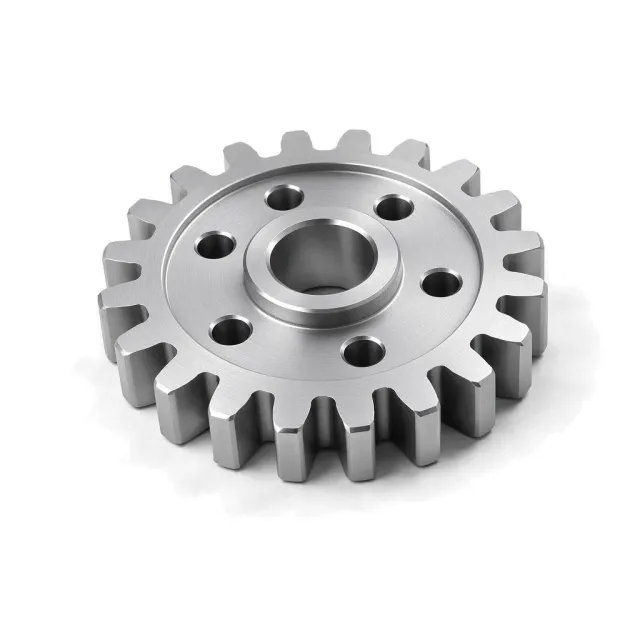
What is Ground?
It is selected for mating, sealing, and tooling faces where machining alone cannot hold the required flatness, size, or texture.
How it works
A rotating abrasive wheel traverses a magnetically or mechanically held workpiece while small downfeeds remove stock. Aluminum-oxide wheels are common for steels; roughly 46–80 grit is common for stock removal and 80–180 grit for finer finishing, while silicon carbide or engineered abrasives suit selected materials. Job-shop surface grinding commonly achieves Ra 0.2–1.6 µm (8–63 µin) and dimensional control around ±0.005 mm. Measure Ra under ASME B46.1 or ISO 21920.
Why specify it
- Can hold about ±0.005 mm on suitable work
- Produces Ra about 0.2–1.6 µm (8–63 µin)
- Creates flat parallel mating faces
- Finishes hardened steel
Where it falls short
- Grinding burn and residual stress are possible
- Magnetic holding does not suit all materials
- Interrupted surfaces can damage the wheel
- Thin parts can warp after unclamping
Ground at a glance
Ground is a middle-of-the-range finish; its best score is cosmetic quality (35 of 100), at a premium cost. It adds little corrosion protection. Surface hardness is not rated: the finish leaves the part's own surface.
Each score is 0–100 against every finish in this catalog. Corrosion comes from salt-spray life (ASTM B117, log scale) and hardness from the finish layer's Vickers or pencil hardness; cosmetic, lubricity and cost are FabDigit's engineering assessment. Economy on the radar is the inverse of cost.
Ground key numbers
Typical values from the governing specifications and shop practice; bars are this finish against the highest value among mechanical finishing finishes.
- Thickness
- No coating; typical resulting Ra 0.2–1.6 µm (8–63 µin).
- Electrical
- Unchanged
- Appearance
- Flat surface with fine parallel or crosshatched grinding lines.
Specifications for Ground
The documents a drawing cites to define this finish, with the Type / Class rows that apply. Each links to a page explaining the standard.
Drawing call-out
SURFACE GRIND DATUM A TO 12.000 ±0.005 mm THICK, FLATNESS 0.005 mm, Ra 0.4 µm MAX; NO GRINDING BURNWhich materials take Ground?
Verdict per material family, with the grades that behave differently. Each family links to its datasheets in the material library.
| Material family | Verdict | Notes |
|---|---|---|
| Yes | Requires burn control and suitable wheel selection. | |
| Yes | Primary application, including hardened tool steels. | |
| With care | Wheel loading requires suitable abrasive, structure, dressing, and coolant. | |
| With care | Loads the wheel; not a first-choice grind substrate. | |
| With care | Diamond grinding and brittle-fracture controls are required. | |
| With care | Loads the wheel and smears; use a dedicated abrasive and light infeed. | |
| With care | Possible with non-sparking media and fire-safe dust control. | |
| With care | Possible with low heat, sharp wheels, and contamination control. | |
| With care | Soft die-cast zinc cuts quickly and can embed media. | |
| No | Surface grinding is for metals and ceramics, not polymers. |
How Ground is applied, and what it does to the part
- 1Stress-relieve if required
- 2Fixture or magnetically chuck part
- 3Dress wheel
- 4Rough and spark-out grind
- 5Inspect size flatness parallelism and Ra
| Dimensions | Suitable setups can hold approximately ±0.005 mm; specify stock allowance, final thickness, flatness, parallelism, and Ra separately. |
|---|---|
| Build-up per side | 0 µm — No buildup; specified machining allowance is removed. |
| Masking | Rarely needed. Only designated faces are ground; protect adjacent finished faces from wheel overtravel and swarf. |
| Electrical | Unchanged |
| Appearance | Flat surface with fine parallel or crosshatched grinding lines. |
| Added lead time | 2–7 working days on top of the bare part |
Design rules for Ground
What to decide on the drawing before the part goes to the finisher.
- Provide grinding allowance.The wheel must remove enough stock to clean the face.
- Dimension size and flatness separately.A smooth surface is not necessarily flat.
- Control heat input.Burn can soften or crack hardened steel.
- Plan workholding.Thin or nonmagnetic parts need special fixtures.
Ground versus the alternatives
Finishes engineers weigh against Ground, and when each wins.
| Finish | Corrosion | Hardness | Cosmetic | Cost | Thickness | Choose it when |
|---|---|---|---|---|---|---|
Ground this page | 0 | — | 35 | $$$ | 0 µm | — |
| 0 | — | 70 | $$$$ | 0 µm | when lower Ra and tighter flatness are required | |
| 8 | — | 82 | $$$ | 0 µm | when appearance rather than precision geometry is primary |
The radar overlays Ground with Lapping, its most common alternative — chosen when lower Ra and tighter flatness are required. Scores in the table are 0–100 across every finish in the catalog.
Cost, lead time and compliance
Relative cost
Surface Grinding is a premium-cost finish ($$$): more expensive than about 51 % of the finishes FabDigit quotes.
Finishing is priced per part with a lot minimum, from FabDigit's own China-side rates. The exact figure appears on the instant quote once the part is uploaded.
Lead time and compliance
| Added lead time | 2–7 working days |
|---|---|
| RoHS | Compliant |
| Notes | Manage grinding swarf, wheel dust, and coolant as metal-bearing waste. |
What Ground is used for
- Tooling plates
- Gauge blocks and fixtures
- Seal lands
- Hardened machine ways
Ground — frequently asked
what tolerance can surface grinding hold
A capable job-shop setup can hold about ±0.005 mm on suitable parts. Part size, material, thermal control, workholding, and inspection can require looser or tighter limits.
what Ra does surface grinding produce
Typical surface grinding produces Ra 0.2–1.6 µm (8–63 µin). Fine wheels and controlled spark-out can improve it.
surface grinding vs lapping
Grinding removes stock quickly with a bonded wheel and can hold about ±0.005 mm. Lapping removes much less with loose abrasive and is used for finer flatness and Ra below 0.1 µm.
what is grinding burn
Grinding burn is thermal damage caused by excessive heat. It can discolor, temper-soften, reharden, or crack the surface even when dimensions pass.
can aluminum be surface ground
Yes, with suitable open-structure wheels, coolant, and dressing. Aluminum loads ordinary wheels quickly and requires special process control.
Other mechanical finishing finishes
 Aluminum Bright DipBright dipping is a chemical polishing pretreatment that levels microscopic peaks on aluminum to produce a reflective surface before anodizing.CorrosionHardnessCost$$
 As MachinedAs machined is the baseline CNC condition with no secondary cosmetic finishing.CorrosionHardnessCost$
 Bead BlastingBead blasting propels spherical media at a surface to make a uniform satin or matte finish.CorrosionHardnessCost$
 Brushed FinishBrushing creates a directional grain with abrasive belts, wheels, or pads.CorrosionHardnessCost$$
 DeburringDeburring removes loose or sharp burrs left by cutting, punching, molding, or casting.CorrosionHardnessCost$
 Edge RoundingEdge rounding deliberately replaces a sharp edge with a controlled radius or broad edge break.CorrosionHardnessCost$
 HoningHoning precision-finishes bores with expanding abrasive stones and a controlled cross-hatch.CorrosionHardnessCost$$$
 Mirror PolishingMirror polishing removes visible directional scratches and buffs the surface to high specular reflectance.CorrosionHardnessCost$$$$