
Superfinishing and Isotropic Superfinishing
Mechanical finishing · Mechanical
Superfinishing removes grinding peaks from bearing and gear surfaces with very fine abrasive action.
Reference page — Superfinishing is not in the instant-quote configurator. Upload the part, name the finish in the notes, and an engineer quotes it with the part.
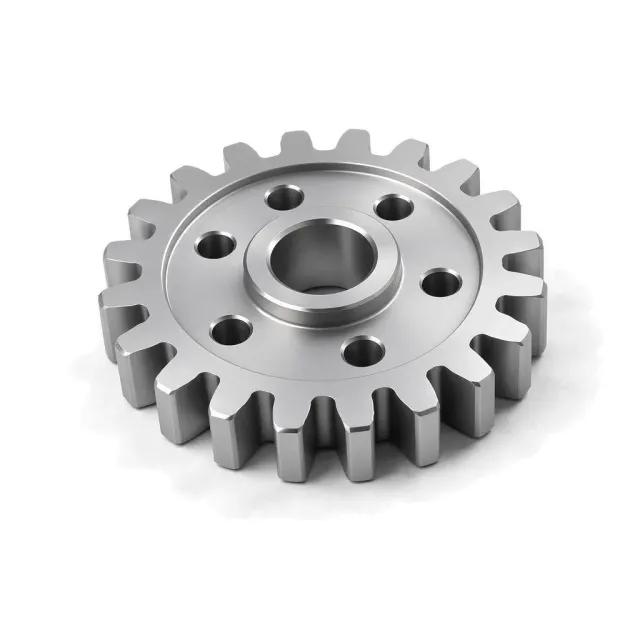
What is Superfinishing?
Isotropic or chemically accelerated mass-finishing systems, often described as REM-class processes, reduce directional texture across complex parts.
How it works
Conventional superfinishing oscillates a fine abrasive stone, often in the 600–1200 grit class, against a slowly moving journal or race under light pressure. Isotropic systems use nonabrasive or fine media with chemistry that forms a soft conversion layer which is repeatedly removed from high points. Typical finished Ra is about 0.02–0.20 µm (0.8–8 µin), reducing asperity contact while changing macrogeometry far less than grinding. Measure the final texture under ASME B46.1 or ISO 21920.
Why specify it
- Produces Ra about 0.02–0.20 µm (0.8–8 µin)
- Reduces friction and break-in wear
- Removes directional grinding peaks
- Improves bearing-area ratio
Where it falls short
- Does not correct major form error
- Specialist equipment and chemistry increase cost
- Chemically accelerated cycles require alloy validation
- Edge protection may be needed
Superfinishing at a glance
Superfinishing is a middle-of-the-range finish; its best score is cosmetic quality (65 of 100), at a high cost. It adds little corrosion protection. Surface hardness is not rated: the finish leaves the part's own surface.
Each score is 0–100 against every finish in this catalog. Corrosion comes from salt-spray life (ASTM B117, log scale) and hardness from the finish layer's Vickers or pencil hardness; cosmetic, lubricity and cost are FabDigit's engineering assessment. Economy on the radar is the inverse of cost.
Superfinishing key numbers
Typical values from the governing specifications and shop practice; bars are this finish against the highest value among mechanical finishing finishes.
- Thickness
- No coating; typical resulting Ra 0.02–0.20 µm (0.8–8 µin).
- Electrical
- Unchanged
- Appearance
- Smooth low-gloss to reflective surface with greatly reduced directional lay.
Specifications for Superfinishing
The documents a drawing cites to define this finish, with the Type / Class rows that apply. Each links to a page explaining the standard.
Drawing call-out
SUPERFINISH BEARING JOURNAL Ø25 TO Ra 0.10 µm MAX AFTER GRINDING; MAINTAIN DIAMETER TOLERANCE AND ROUNDNESS 0.003 mmWhich materials take Superfinishing?
Verdict per material family, with the grades that behave differently. Each family links to its datasheets in the material library.
| Material family | Verdict | Notes |
|---|---|---|
| Yes | Suitable with alloy-compatible abrasive or chemistry. | |
| Yes | Primary substrate for gears, races, and journals.
| |
| With care | Possible with non-sparking media and fire-safe dust control. | |
| With care | Specialist process development is required. | |
| With care | Requires specialist chemistry and hydrogen-control review. | |
| With care | Soft die-cast zinc cuts quickly and can embed media. | |
| Limited | Soft aluminum embeds abrasive and does not hold a bearing-race superfinish. | |
| Limited | Soft brass smears under stone or tape superfinishing. | |
| Limited | Soft copper smears; not a typical superfinish substrate. | |
| No | Superfinishing is for hard metal journals and races, not polymers. |
How Superfinishing is applied, and what it does to the part
- 1Pre-grind to geometry
- 2Select stone or isotropic chemistry and media
- 3Superfinish under controlled load
- 4Neutralize and clean if chemical
- 5Inspect Ra form and material ratio
| Dimensions | Removes microscopic peaks with little macrogeometry change, but stock removal and edge effects must be qualified on precision parts. |
|---|---|
| Build-up per side | 0 µm — No buildup; microscopic peaks are selectively removed. |
| Masking | Usually needed. Protect edges, fits, threads, and surfaces not intended for chemically accelerated treatment. |
| Electrical | Unchanged |
| Appearance | Smooth low-gloss to reflective surface with greatly reduced directional lay. |
| Added lead time | 3–10 working days on top of the bare part |
Design rules for Superfinishing
What to decide on the drawing before the part goes to the finisher.
- Finish geometry before superfinishing.The process removes peaks but not major form error.
- Specify Ra and material-ratio needs.Friction depends on more than average roughness.
- Validate alloy chemistry.Accelerated isotropic processes are chemistry-sensitive.
- Protect sharp edges and threads.Mass action can alter exposed features.
Superfinishing versus the alternatives
Finishes engineers weigh against Superfinishing, and when each wins.
| Finish | Corrosion | Hardness | Cosmetic | Cost | Thickness | Choose it when |
|---|---|---|---|---|---|---|
Superfinishing this page | 5 | — | 65 | $$$$ | 0 µm | — |
| 0 | — | 70 | $$$$ | 0 µm | when flatness of a planar face is primary | |
| 0 | — | 25 | $$$ | 0 µm | when a bore requires cross-hatch and geometric correction |
The radar overlays Superfinishing with Lapping, its most common alternative — chosen when flatness of a planar face is primary. Scores in the table are 0–100 across every finish in the catalog.
Cost, lead time and compliance
Relative cost
Superfinishing and Isotropic Superfinishing is a high-cost finish ($$$$): more expensive than about 80 % of the finishes FabDigit quotes.
Finishing is priced per part with a lot minimum, from FabDigit's own China-side rates. The exact figure appears on the instant quote once the part is uploaded.
Lead time and compliance
| Added lead time | 3–10 working days |
|---|---|
| RoHS | Compliant |
| Notes | Chemically accelerated systems require controlled bath, neutralization, and waste treatment. |
What Superfinishing is used for
- Bearing races
- Crankshaft journals
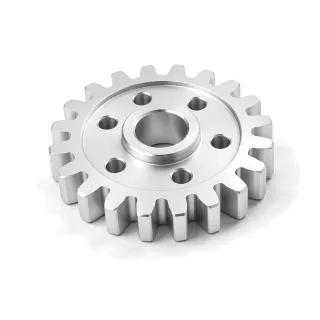
- Transmission gears
- Aerospace rolling contacts
Superfinishing — frequently asked
what is isotropic superfinishing
It removes directional machining peaks to create a more uniform low-roughness surface. Chemically accelerated mass-finishing variants repeatedly form and remove a soft surface layer at high points.
what Ra does superfinishing achieve
Typical production results are about Ra 0.02–0.20 µm (0.8–8 µin). The incoming grind, abrasive, time, load, and alloy control the result.
what is REM finishing
REM is a trademark associated with proprietary chemically accelerated isotropic finishing processes. It is often used informally as a process class, but drawings should identify the approved supplier process and measurable result.
superfinishing vs polishing
Polishing often prioritizes gloss and can change edges and form. Superfinishing targets load-bearing peaks and friction while preserving previously ground macrogeometry.
does superfinishing improve gear life
Reducing asperity peaks can lower friction, scuffing risk, and break-in debris. Life improvement depends on load, lubrication, hardness, geometry, and the verified final texture.
Other mechanical finishing finishes
 Aluminum Bright DipBright dipping is a chemical polishing pretreatment that levels microscopic peaks on aluminum to produce a reflective surface before anodizing.CorrosionHardnessCost$$
 As MachinedAs machined is the baseline CNC condition with no secondary cosmetic finishing.CorrosionHardnessCost$
 Bead BlastingBead blasting propels spherical media at a surface to make a uniform satin or matte finish.CorrosionHardnessCost$
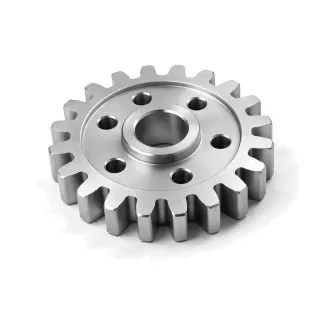 Brushed FinishBrushing creates a directional grain with abrasive belts, wheels, or pads.CorrosionHardnessCost$$
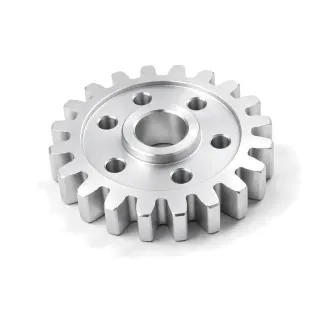 DeburringDeburring removes loose or sharp burrs left by cutting, punching, molding, or casting.CorrosionHardnessCost$
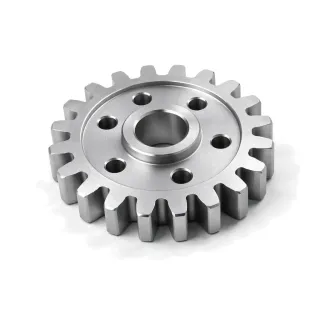 Edge RoundingEdge rounding deliberately replaces a sharp edge with a controlled radius or broad edge break.CorrosionHardnessCost$
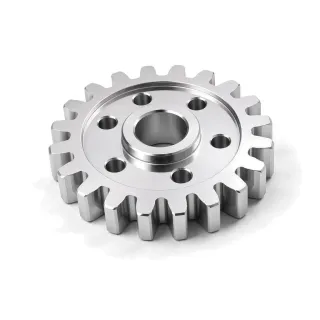 Mirror PolishingMirror polishing removes visible directional scratches and buffs the surface to high specular reflectance.CorrosionHardnessCost$$$$
 PolishingMechanical polishing progressively removes surface peaks and scratches to produce a smooth glossy surface.CorrosionHardnessCost$$$