
Shot Peening
Mechanical finishing · Mechanical
Shot peening bombards metal with controlled shot to create compressive residual stress and improve fatigue and stress-corrosion resistance.
Reference page — Shot peening is not in the instant-quote configurator. Upload the part, name the finish in the notes, and an engineer quotes it with the part.
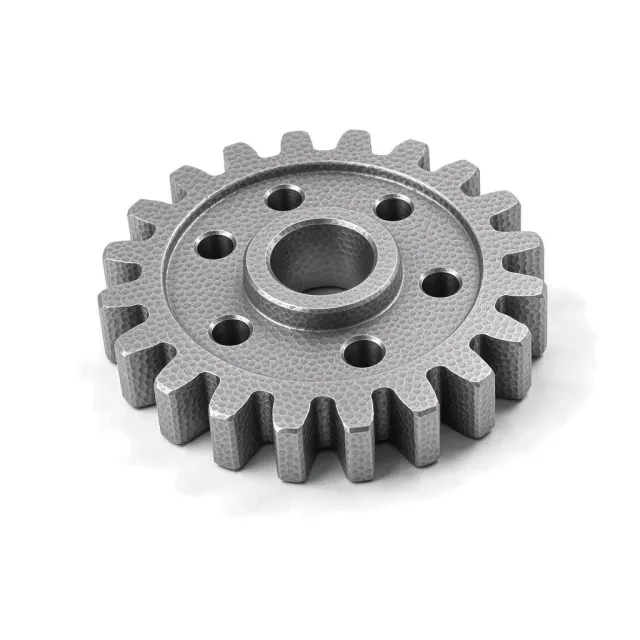
What is Shot peening?
It is a mechanical treatment, not a coating, and aerospace drawings commonly control media, Almen intensity, coverage, and AMS 2430 compliance.
How it works
Spherical steel, glass, ceramic, or conditioned-cut-wire shot strikes the surface and plastically dimples a shallow layer. Elastic material beneath constrains that layer, leaving beneficial compressive residual stress. An Almen strip and arc-height reading verify process intensity; visual or instrumented methods verify coverage. Excess intensity, poor media, or thin walls can distort or damage the part.
Why specify it
- Introduces compressive residual stress
- Can improve fatigue life
- No deposited coating thickness
- Controlled by Almen intensity and coverage
Where it falls short
- Can distort thin walls
- Raises or changes surface texture
- Does not provide corrosion protection
- Cannot rescue cracks or poor geometry
Shot peening at a glance
Shot peening is a middle-of-the-range finish; its best score is cosmetic quality (25 of 100), at a premium cost. It adds little corrosion protection. Surface hardness is not rated: the finish leaves the part's own surface.
Each score is 0–100 against every finish in this catalog. Corrosion comes from salt-spray life (ASTM B117, log scale) and hardness from the finish layer's Vickers or pencil hardness; cosmetic, lubricity and cost are FabDigit's engineering assessment. Economy on the radar is the inverse of cost.
Specifications for Shot peening
The documents a drawing cites to define this finish, with the Type / Class rows that apply. Each links to a page explaining the standard.
Drawing call-out
SHOT PEEN PER AMS 2430 USING CONDITIONED CUT WIRE, ALMEN INTENSITY 0.15–0.30 mmA, 100% COVERAGE MIN; MASK THREADS AND BEARING BORES; DISTORTION 0.05 mm MAXWhich materials take Shot peening?
Verdict per material family, with the grades that behave differently. Each family links to its datasheets in the material library.
| Material family | Verdict | Notes |
|---|---|---|
| Yes | Use lower intensity and qualified media for thin or soft parts. | |
| Yes | Common on turbine and fatigue-critical parts. | |
| Yes | Use contamination-compatible media. | |
| Yes | Widely used for gears, springs, and shafts. | |
| Yes | Aerospace use requires controlled media and contamination prevention. | |
| With care | Possible with non-sparking media and fire-safe dust control. | |
| With care | Soft die-cast zinc cuts quickly and can embed media. | |
| Limited | Soft brass distorts at intensities used for steel fatigue work. | |
| Limited | Soft copper alloys deform and fold rather than develop a useful compressive layer. | |
| No | Shot peening is a metal fatigue process, not a polymer finish. |
How Shot peening is applied, and what it does to the part
- 1Clean
- 2Mask
- 3Select and qualify media
- 4Set intensity with Almen strips
- 5Peen to specified coverage
- 6Verify coverage and distortion
| Dimensions | No nominal coating growth, but peening can bow thin sections and alter surface roughness; set distortion limits. |
|---|---|
| Build-up per side | 0 µm — No coating buildup; local plastic deformation and distortion remain possible. |
| Masking | Usually needed. Mask threads, seal lands, thin edges, precision bores, and surfaces excluded by stress analysis. |
| Electrical | Unchanged |
| Appearance | Uniform peened matte texture; colour remains that of the substrate. |
| Added lead time | 3–7 working days on top of the bare part |
Design rules for Shot peening
What to decide on the drawing before the part goes to the finisher.
- State Almen strip type and intensity range.Intensity without A, N, or C strip designation is incomplete.
- Specify coverage percentage.Intensity does not prove every required area was impacted.
- Define shot media.Size, hardness, and shape affect the stress field and contamination.
- Mask stress-sensitive features.Threads, sharp edges, and thin walls can be damaged.
Shot peening versus the alternatives
Finishes engineers weigh against Shot peening, and when each wins.
| Finish | Corrosion | Hardness | Cosmetic | Cost | Thickness | Choose it when |
|---|---|---|---|---|---|---|
Shot peening this page | 10 | — | 25 | $$$ | — | — |
| 5 | — | 50 | $ | 0 µm | when only edge conditioning and cosmetic uniformity are needed, not compressive stress | |
| 5 | — | 65 | $ | 0 µm | when a matte appearance is the goal and fatigue life is not a requirement |
The radar overlays Shot peening with Tumbling and Vibratory Finishing, its most common alternative — chosen when only edge conditioning and cosmetic uniformity are needed, not compressive stress. Scores in the table are 0–100 across every finish in the catalog.
Cost, lead time and compliance
Relative cost
Shot Peening is a premium-cost finish ($$$): more expensive than about 51 % of the finishes FabDigit quotes.
Finishing is priced per part with a lot minimum, from FabDigit's own China-side rates. The exact figure appears on the instant quote once the part is uploaded.
Lead time and compliance
| Added lead time | 3–7 working days |
|---|---|
| RoHS | Compliant |
| Notes | No coating chemistry is deposited; media dust and ferrous contamination must be controlled. |
What Shot peening is used for
- Gears
- Springs
- Landing-gear parts
- Turbine components
Shot peening — frequently asked
What is Almen intensity in shot peening?
It is the arc height produced on a standardized strip at saturation. A callout such as 0.15–0.30 mmA identifies both the range and A-strip type.
What does 100% shot peening coverage mean?
It means the specified surface shows complete visual impact coverage, not that every point was struck once. Some programs specify 200% coverage by doubling exposure time after 100% is reached.
Does shot peening add thickness?
No coating is deposited, so nominal buildup is 0 µm. Plastic deformation can still change roughness and distort thin sections.
Shot peening vs bead blasting: what is the difference?
Shot peening is controlled for residual stress using qualified media, Almen intensity, and coverage. Bead blasting is usually an appearance or cleaning operation without fatigue-process control.
What does AMS 2430 specify?
AMS 2430 is widely used for controlled shot peening of metal parts. The drawing still needs media, Almen strip and intensity, coverage, masking, and any distortion limits.
Other mechanical finishing finishes
 Aluminum Bright DipBright dipping is a chemical polishing pretreatment that levels microscopic peaks on aluminum to produce a reflective surface before anodizing.CorrosionHardnessCost$$
 As MachinedAs machined is the baseline CNC condition with no secondary cosmetic finishing.CorrosionHardnessCost$
 Brushed FinishBrushing creates a directional grain with abrasive belts, wheels, or pads.CorrosionHardnessCost$$
 DeburringDeburring removes loose or sharp burrs left by cutting, punching, molding, or casting.CorrosionHardnessCost$
 Edge RoundingEdge rounding deliberately replaces a sharp edge with a controlled radius or broad edge break.CorrosionHardnessCost$
 HoningHoning precision-finishes bores with expanding abrasive stones and a controlled cross-hatch.CorrosionHardnessCost$$$
 LappingLapping is a precision loose-abrasive process used to improve flatness, parallelism, and very fine roughness.CorrosionHardnessCost$$$$
 Mirror PolishingMirror polishing removes visible directional scratches and buffs the surface to high specular reflectance.CorrosionHardnessCost$$$$