
Sand Blasting
Mechanical finishing · Mechanical
Sand blasting uses angular abrasive to remove scale, rust, and coatings or to create a rough coating-ready surface.
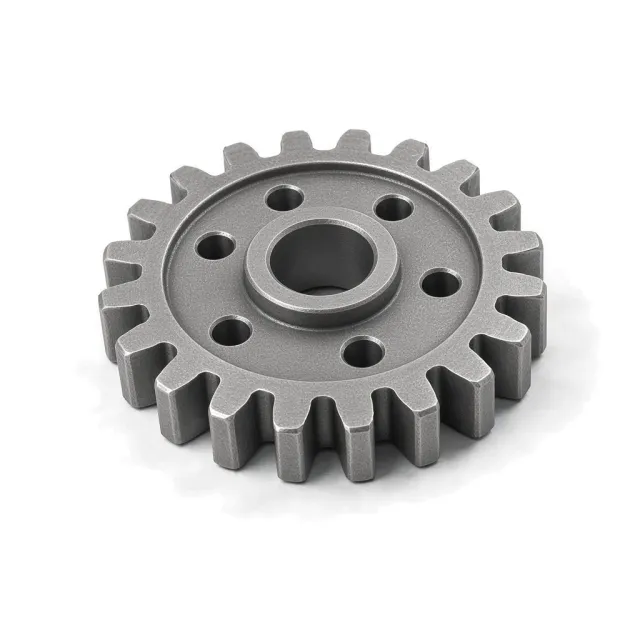
What is Sand blast?
Modern shops normally use alumina, garnet, or other controlled grit rather than free silica sand.
How it works
Air or wheel blasting drives angular abrasive into the substrate, cutting peaks and removing contamination. Alumina from 60–220 grit covers aggressive cleaning through finer preparation; 60–120 grit is common for coating key. Blast cleanliness may be specified under ISO 8501-1 or an SSPC-SP visual preparation grade, while final roughness is measured under ASME B46.1 or ISO 21920. Profile and cleanliness require separate acceptance criteria.
Why specify it
- Removes rust, scale, and old coating
- Creates mechanical key for paint or powder coat
- Reaches complex external geometry
- Produces Ra about 3.2–12.5 µm (125–500 µin) in common job-shop work
Where it falls short
- Can warp thin sheet
- Rounds edges and erodes small features
- May embed abrasive or contaminate stainless
- Free silica sand presents a serious inhalation hazard
Sand blast at a glance
Sand blast is a middle-of-the-range finish; its best score is cosmetic quality (35 of 100), at a budget cost. It adds little corrosion protection or lubricity. Surface hardness is not rated: the finish leaves the part's own surface.
Each score is 0–100 against every finish in this catalog. Corrosion comes from salt-spray life (ASTM B117, log scale) and hardness from the finish layer's Vickers or pencil hardness; cosmetic, lubricity and cost are FabDigit's engineering assessment. Economy on the radar is the inverse of cost.
Sand blast key numbers
Typical values from the governing specifications and shop practice; bars are this finish against the highest value among mechanical finishing finishes.
- Thickness
- No coating; typical resulting Ra 3.2–12.5 µm (125–500 µin).
- Electrical
- Unchanged
- Appearance
- Rough, non-directional matte surface.
Specifications for Sand blast
The documents a drawing cites to define this finish, with the Type / Class rows that apply. Each links to a page explaining the standard.
Drawing call-out
ABRASIVE BLAST EXTERNAL SURFACES WITH 120 GRIT ALUMINUM OXIDE TO Ra 6.3–10 µm, ISO 8501-1 Sa 2½, MASK THREADS AND DATUMSWhich materials take Sand blast?
Verdict per material family, with the grades that behave differently. Each family links to its datasheets in the material library.
| Material family | Verdict | Notes |
|---|---|---|
| Yes | Suitable; protect against smear and media embedment. | |
| Yes | Suitable; expect faster cutting and easier smearing than steel. | |
| Yes | Standard preparation for scale removal and coating key. | |
| With care | Soft substrate erodes quickly and thin sections can distort. | |
| With care | Possible with non-sparking media and fire-safe dust control. | |
| With care | Use dedicated clean media to prevent free-iron contamination. | |
| With care | Use iron-free alumina or garnet; silica sand is the wrong media and a health hazard. | |
| With care | Soft die-cast zinc cuts quickly and can embed media. | |
| Limited | Angular grit rapidly erodes plastics; use only for controlled texture trials. |
How Sand blast is applied, and what it does to the part
- 1Degrease
- 2Mask critical areas
- 3Blast with specified 60–220 grit abrasive
- 4Remove residual abrasive
- 5Verify cleanliness profile and Ra
| Dimensions | Material is removed and edges are rounded; removal is process-dependent and must not be assumed zero on close-tolerance features. |
|---|---|
| Build-up per side | 0 µm — No buildup; measurable cutting depends on grit, pressure, dwell, and substrate. |
| Masking | Usually needed. Mask threads, fits, sealing faces, labels, and thin or fragile features. |
| Electrical | Unchanged |
| Appearance | Rough, non-directional matte surface. |
| Added lead time | 1–3 working days on top of the bare part |
Design rules for Sand blast
What to decide on the drawing before the part goes to the finisher.
- Specify abrasive type and grit.Alumina 60 grit cuts far more aggressively than 220 grit.
- State the cleanliness grade.ISO 8501 and SSPC-SP grades describe contamination removal, not Ra.
- Protect thin sheet.Peening stress and heat can distort panels.
- Use dedicated media for stainless.Carbon-steel contamination can create rust spots.
Sand blast versus the alternatives
Finishes engineers weigh against Sand blast, and when each wins.
| Finish | Corrosion | Hardness | Cosmetic | Cost | Thickness | Choose it when |
|---|---|---|---|---|---|---|
Sand blast this page | 0 | — | 35 | $ | 0 µm | — |
| 5 | — | 65 | $ | 0 µm | when a gentler cosmetic satin finish is required | |
| 5 | — | 70 | $$ | 0 µm | when dust and dry-media embedment must be reduced |
The radar overlays Sand blast with Bead Blasting, its most common alternative — chosen when a gentler cosmetic satin finish is required. Scores in the table are 0–100 across every finish in the catalog.
Cost, lead time and compliance
Relative cost
Sand Blasting is a budget-cost finish ($): cheaper than about 85 % of the finishes FabDigit quotes.
Finishing is priced per part with a lot minimum, from FabDigit's own China-side rates cross-checked against US job-shop pricing. The exact figure appears on the instant quote once the part is uploaded.
Lead time and compliance
| Added lead time | 1–3 working days |
|---|---|
| RoHS | Compliant |
| Notes | Use contained blasting and dust collection; avoid free crystalline silica abrasive. |
What Sand blast is used for
- Steel weldments before coating
- Castings before paint
- Rust removal
- Slip-resistant industrial surfaces
Sand blast — frequently asked
bead blast vs sand blast
Sand blasting uses angular cutting grit and commonly leaves Ra 3.2–12.5 µm (125–500 µin). Glass bead is spherical, gentler, and commonly leaves Ra 1.6–6.3 µm (63–250 µin).
what grit is used for sand blasting
Aluminum oxide from 60–220 grit is common. Coarse 60–120 grit cleans and profiles aggressively; finer 180–220 grit makes a less coarse texture.
what is Sa 2.5 blast cleaning
ISO 8501-1 Sa 2½ is very thorough blast cleaning with only slight traces of contamination remaining. It is a cleanliness grade, not a roughness value.
does sand blasting remove material
Yes. Removal varies with abrasive, pressure, angle, dwell, and hardness, so close-tolerance surfaces must be masked or machined afterward.
can stainless steel be sand blasted
Yes, with clean stainless-dedicated media and equipment. Carbon-steel carryover can create free-iron contamination and later rust staining.
Other mechanical finishing finishes
 Aluminum Bright DipBright dipping is a chemical polishing pretreatment that levels microscopic peaks on aluminum to produce a reflective surface before anodizing.CorrosionHardnessCost$$
 As MachinedAs machined is the baseline CNC condition with no secondary cosmetic finishing.CorrosionHardnessCost$
 Brushed FinishBrushing creates a directional grain with abrasive belts, wheels, or pads.CorrosionHardnessCost$$
 DeburringDeburring removes loose or sharp burrs left by cutting, punching, molding, or casting.CorrosionHardnessCost$
 Edge RoundingEdge rounding deliberately replaces a sharp edge with a controlled radius or broad edge break.CorrosionHardnessCost$
 HoningHoning precision-finishes bores with expanding abrasive stones and a controlled cross-hatch.CorrosionHardnessCost$$$
 LappingLapping is a precision loose-abrasive process used to improve flatness, parallelism, and very fine roughness.CorrosionHardnessCost$$$$
 Mirror PolishingMirror polishing removes visible directional scratches and buffs the surface to high specular reflectance.CorrosionHardnessCost$$$$