
Vapor Smoothing
3D-print & moulding post-processing · Chemical bath
Vapor smoothing briefly softens the outer skin of compatible powder-bed polymers so surface peaks flow together.
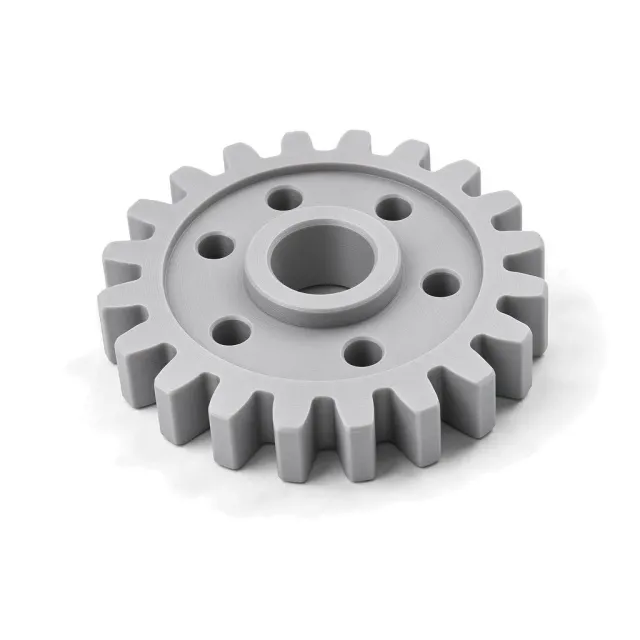
What is Vapor smoothing?
Qualified systems are used on PA12 and PA11 MJF or SLS parts and selected TPU grades.
How it works
Parts are exposed in a controlled chamber to a solvent vapor matched to the polymer. A shallow surface layer swells and reflows, reducing powder texture and partially sealing connected surface porosity; controlled drying removes residual solvent. Typical finished Ra is about 0.8–6.3 µm (32–250 µin), compared with rougher as-printed powder-bed surfaces. Exposure, drainage, geometry, dye, and exact polymer grade require a validated recipe.
Why specify it
- Reduces Ra to about 0.8–6.3 µm (32–250 µin)
- Improves cleanability and gloss
- Can reduce surface-connected porosity
- Reaches complex external geometry
Where it falls short
- Only works with qualified polymer and chemistry pairs
- Rounds fine texture and small edges
- Can trap condensate in cavities
- Does not guarantee pressure tightness
Vapor smoothing at a glance
Vapor smoothing is strongest on cosmetic quality (80 of 100), at a premium cost. Corrosion protection and surface hardness are not rated: a plastic part does not corrode, and the finish leaves the part's own surface.
Each score is 0–100 against every finish in this catalog. Corrosion comes from salt-spray life (ASTM B117, log scale) and hardness from the finish layer's Vickers or pencil hardness; cosmetic, lubricity and cost are FabDigit's engineering assessment. Economy on the radar is the inverse of cost.
Vapor smoothing key numbers
Typical values from the governing specifications and shop practice; bars are this finish against the highest value among 3d-print & moulding post-processing finishes.
- Thickness
- No deposited coating; typical finished Ra 0.8–6.3 µm (32–250 µin).
- Electrical
- Unchanged
- Appearance
- Smoother satin to glossy polymer surface with reduced powder grain.
Specifications for Vapor smoothing
The documents a drawing cites to define this finish, with the Type / Class rows that apply. Each links to a page explaining the standard.
Drawing call-out
VAPOR SMOOTH MJF PA12 EXTERNAL SURFACES TO Ra 3.2 µm MAX; MASK DATUM A AND THREADS; NO POOLING OR BLOCKED PASSAGESWhich materials take Vapor smoothing?
Verdict per material family, with the grades that behave differently. Each family links to its datasheets in the material library.
| Material family | Verdict | Notes |
|---|---|---|
| Yes | PA12 and selected PA11 or TPU grades are common qualified applications.
| |
| Yes | PA12 and PA11 are common qualified vapor-smoothing applications. | |
| With care | Only qualified PA12, PA11, selected TPU, and a few other thermoplastics reflow in commercial vapor systems. | |
| Limited | Use chemical-smoothing for solvent-compatible FDM polymers; commercial PA vapor systems are not an FDM default. | |
| No | This is a polymer additive or moulded-plastic finishing step, not a bulk-aluminum process. | |
| No | This is a polymer finishing step, not a brass process. | |
| No | This is a polymer finishing step, not a copper-alloy process. | |
| No | Metal AM does not vapor-smooth. | |
| No | This is a polymer finishing step, not a magnesium process. | |
| No | Thermoset photopolymer does not reflow like powder-bed nylon. | |
| No | This is a polymer finishing step, not a stainless process. | |
| No | This is a polymer finishing step, not a steel process. | |
| No | This is a polymer finishing step, not a titanium process. | |
| No | This is a polymer finishing step, not a zinc process. |
How Vapor smoothing is applied, and what it does to the part
- 1Clean and depowder
- 2Load with drainage orientation
- 3Run polymer-specific vapor cycle
- 4Dry and condition
- 5Inspect dimensions Ra and cleanliness
| Dimensions | Surface reflow can round edges, close small gaps, and shift precision fits; validate coupons and machine tight interfaces afterward. |
|---|---|
| Build-up per side | 0 µm — Surface reflows rather than receiving a coating; edge rounding and local dimensional shift are possible. |
| Masking | Usually needed. Mask precision interfaces where the qualified system permits; otherwise machine critical fits after smoothing. |
| Electrical | Unchanged |
| Appearance | Smoother satin to glossy polymer surface with reduced powder grain. |
| Added lead time | 2–7 working days on top of the bare part |
Design rules for Vapor smoothing
What to decide on the drawing before the part goes to the finisher.
- Name the exact polymer grade.PA12, PA11, and TPU recipes are not interchangeable.
- Provide drain paths.Condensate can pool in cavities.
- Keep tiny text and edges oversized.Reflow softens fine detail.
- Validate pressure requirements separately.A smoother surface is not proof of leak tightness.
Vapor smoothing versus the alternatives
Finishes engineers weigh against Vapor smoothing, and when each wins.
| Finish | Corrosion | Hardness | Cosmetic | Cost | Thickness | Choose it when |
|---|---|---|---|---|---|---|
Vapor smoothing this page | — | — | 80 | $$$ | 0 µm | — |
| — | — | 75 | $$$ | 0 µm | when FDM ABS or a resin-specific liquid solvent process is intended | |
| 30 | — | 55 | $$$ | ≥ 0 µm | when pore sealing rather than reflow is primary |
The radar overlays Vapor smoothing with Chemical Smoothing, its most common alternative — chosen when FDM ABS or a resin-specific liquid solvent process is intended. Scores in the table are 0–100 across every finish in the catalog.
Cost, lead time and compliance
Relative cost
Vapor Smoothing is a premium-cost finish ($$$): more expensive than about 63 % of the finishes FabDigit quotes.
Finishing is priced per part with a lot minimum, from FabDigit's own China-side rates cross-checked against US job-shop pricing. The exact figure appears on the instant quote once the part is uploaded.
Lead time and compliance
| Added lead time | 2–7 working days |
|---|---|
| RoHS | Compliant |
| Notes | Closed equipment must recover solvent and verify residual-solvent limits appropriate to the application. |
What Vapor smoothing is used for
- MJF PA12 manifolds
- SLS PA11 housings
- Selected TPU wearables
- Cleanable medical-device prototypes
Vapor smoothing — frequently asked
vapor smoothing MJF
Qualified vapor systems can smooth MJF PA12 and selected PA11 or TPU grades to roughly Ra 0.8–6.3 µm (32–250 µin). Exact chemistry, exposure, and conditioning are proprietary and grade-specific.
does vapor smoothing make PA12 waterproof
It can reduce surface-connected porosity, but it does not automatically make a part pressure-tight. Leak testing at the required pressure and duration is still necessary.
can TPU be vapor smoothed
Only selected TPU grades work with qualified commercial systems. Flexibility, swelling, tack, and dimensional change must be tested on the exact grade.
does vapor smoothing change dimensions
It can round edges, soften small text, close narrow gaps, and alter fits. Machine precision interfaces afterward or qualify them with coupons.
vapor smoothing vs bead blasting MJF
Bead blasting removes loose powder and evens the matte appearance but commonly leaves Ra 1.6–6.3 µm. Vapor smoothing reflows the polymer skin and can create a smoother, glossier, more cleanable surface.
Other 3d-print & moulding post-processing finishes
 DegatingDegating removes the runner and gate from a molded or cast part.CorrosionHardnessCost$
 Support RemovalSupport removal separates sacrificial print structures and cleans their attachment scars.CorrosionHardnessCost$$
 TrimmingTrimming removes flash, excess edge material, membranes, or sacrificial tabs.CorrosionHardnessCost$
Compare every 3d-print & moulding post-processing finish side by side →