
Titanium Color Anodizing
Anodizing & conversion coatings · Electrolytic bath
Titanium color anodizing grows a transparent oxide whose interference color identifies parts or provides a decorative finish without dyes.
Reference page — Titanium anodize is not in the instant-quote configurator. Upload the part, name the finish in the notes, and an engineer quotes it with the part.
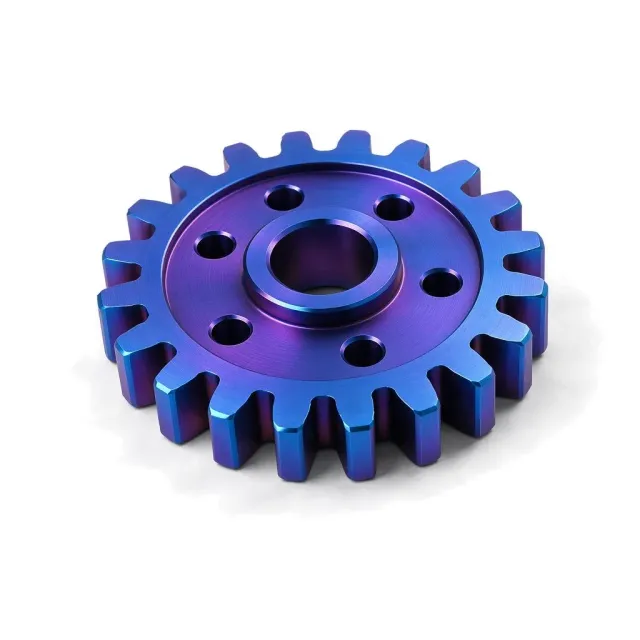
What is Titanium anodize?
It is a voltage-controlled shop process, not AMS 2488 Type 2 (that designation is a thicker anti-galling anodic treatment). Exact color must be controlled by approved process and sample because geometry and alloy affect voltage response.
How it works
Clean titanium is made anodic in a suitable electrolyte. Applied voltage controls the nanometer-scale titanium-dioxide thickness, and reflected light interferes within that transparent film to produce gold, purple, blue, green, and other colors without pigment. Decorative colors generally correspond to roughly 0.03–0.20 µm oxide. Current falls as the insulating film reaches the voltage-controlled thickness. Surface finish, electrolyte, alloy, contact location, and voltage uniformity influence the observed color.
Why specify it
- Produces color with only about 0.03–0.20 µm oxide
- Adds negligible dimensional change
- No dye can fade or leach from the oxide
- Useful for medical-part identification and decorative titanium
Where it falls short
- Color shifts with viewing angle and starting finish
- Scratching removes the optical oxide
- No single universal voltage guarantees a named color
- Not a major wear or corrosion barrier
Titanium anodize at a glance
Titanium anodize is strongest on cosmetic quality (92 of 100), at a standard cost. Surface hardness is not rated: the finish leaves the part's own surface.
Each score is 0–100 against every finish in this catalog. Corrosion comes from salt-spray life (ASTM B117, log scale) and hardness from the finish layer's Vickers or pencil hardness; cosmetic, lubricity and cost are FabDigit's engineering assessment. Economy on the radar is the inverse of cost.
Titanium anodize key numbers
Typical values from the governing specifications and shop practice; bars are this finish against the highest value among anodizing & conversion coatings finishes.
- Thickness
- Approximately 30–200 nm for interference colors; control is normally by voltage and approved color sample.
- Electrical
- Insulating
- Colours
- gold
- purple
- blue
- green
- bronze
- custom voltage color
- Appearance
- Iridescent interference color that follows the original polish, bead blast, or machining texture.
Specifications for Titanium anodize
The documents a drawing cites to define this finish, with the Type / Class rows that apply. Each links to a page explaining the standard.
| Standard | Type / Class | Thickness | Requirement / test | Status |
|---|---|---|---|---|
Anodic Treatment, Titanium and Titanium Alloys, Solution pH 13 or Higher · SAE | Type 2 | ≤ 3 µm | Default anti-galling, galvanic-isolation, wear, and solid-film-lubricant pretreatment coating. · No measurable dimensional change with a 0.0001 in micrometer; lubricated AMS 4928 wear specimens must reach at least 75000 cycles. | Active |
Drawing call-out
ANODIZE TITANIUM FOR COLOR, BLUE, MATCH APPROVED LIMIT SAMPLE FD-TI-BL-01; MASK THREADS AND ELECTRICAL CONTACTSPattern: TITANIUM ANODIZE PER AMS 2488 TYPE <1|2>, [AREAS], [SOLID-FILM LUBRICANT], [MASKING]
Which materials take Titanium anodize?
Verdict per material family, with the grades that behave differently. Each family links to its datasheets in the material library.
| Material family | Verdict | Notes |
|---|---|---|
| Yes | Titanium DMLS/SLM parts are commonly color-anodized after support removal and finishing. | |
| Yes | Commercially pure and common titanium alloys can be color anodized.
| |
| No | Aluminum requires sulfuric, chromic, or other aluminum anodizing. | |
| No | Brass is not titanium-anodized. | |
| No | Copper alloys are not titanium-anodized. | |
| No | Fused-filament polymers are incompatible with this process. | |
| No | Magnesium uses a different anodic process. | |
| No | Polymer powder-bed prints are incompatible with this process. | |
| No | Organic polymers cannot take this inorganic metal-finishing process. | |
| No | Photopolymer prints are incompatible with this process. | |
| No | Polymer powder-bed prints are incompatible with this process. | |
| No | Stainless steel uses different coloring or PVD routes. | |
| No | Steel cannot be color-anodized by this titanium process. | |
| No | Zinc alloys are incompatible. |
How Titanium anodize is applied, and what it does to the part
- 1Clean / degrease
- 2Pickle / activate
- 3Rinse
- 4Anodize at controlled voltage
- 5Dry
- 6Compare with approved sample
| Dimensions | At roughly 0.03–0.20 µm, buildup is negligible; electrical insulation and color consistency are the design concerns. |
|---|---|
| Build-up per side | 0.03–0.2 µm — Dimensional effect is negligible for ordinary machined tolerances. |
| Masking | Usually needed. Mask electrical contacts, grounding surfaces, and any area whose oxide color must not change. |
| Electrical | Insulating |
| Appearance | Iridescent interference color that follows the original polish, bead blast, or machining texture. |
| Added lead time | 3–7 working days on top of the bare part |
Design rules for Titanium anodize
What to decide on the drawing before the part goes to the finisher.
- Approve physical upper and lower color samples.Named colors do not define voltage, hue, or viewing-angle limits.
- Keep alloys and starting finishes consistent.Surface texture and metallurgy alter perceived color.
- Provide a hidden rack contact.Electrical contact leaves an unanodized witness.
- Mask grounding areas.Even a submicrometer titanium oxide is electrically insulating.
Titanium anodize versus the alternatives
Finishes engineers weigh against Titanium anodize, and when each wins.
| Finish | Corrosion | Hardness | Cosmetic | Cost | Thickness | Choose it when |
|---|---|---|---|---|---|---|
Titanium anodize this page | 25 | — | 92 | $$ | 0.03–0.2 µm | — |
| 45 | 87 | 88 | $$$$ | 1–5 µm | when a durable gold appearance must survive handling and abrasion | |
| 5 | — | 65 | $ | 0 µm | when a uniform matte titanium look without colour is enough |
The radar overlays Titanium anodize with Titanium Nitride PVD, its most common alternative — chosen when a durable gold appearance must survive handling and abrasion. Scores in the table are 0–100 across every finish in the catalog.
Cost, lead time and compliance
Relative cost
Titanium Color Anodizing is a standard-cost finish ($$): cheaper than about 57 % of the finishes FabDigit quotes.
Finishing is priced per part with a lot minimum, from FabDigit's own China-side rates. The exact figure appears on the instant quote once the part is uploaded.
Lead time and compliance
| Added lead time | 3–7 working days |
|---|---|
| RoHS | Compliant |
| Notes | Color anodizing can be free of dyes and hexavalent chromium; verify electrolyte and cleaning chemistry. |
What Titanium anodize is used for
- Medical instrument identification
- Titanium fastener color coding
- Jewelry and watch parts
- Aerospace titanium identification
Titanium anodize — frequently asked
How does titanium anodizing make colors?
Voltage grows a transparent titanium-oxide film roughly 30–200 nm thick. Light interference in that film produces color without dye or pigment.
Does titanium anodizing add thickness?
Yes technically, but the 0.03–0.20 µm optical oxide is negligible for normal mechanical tolerances. It can still electrically insulate a contact.
Does titanium anodizing fade?
The oxide contains no dye, so it does not fade like an organic colorant. Abrasion, fingerprints, contamination, and surface damage can still change its appearance.
What voltage makes blue titanium?
There is no universal drawing-safe voltage because electrolyte, alloy, finish, and equipment shift the result. Specify the governing process and an approved color sample rather than voltage alone.
Is titanium color anodizing wear resistant?
No; the color film is only tens to hundreds of nanometers thick. Use a qualified hard coating where abrasion is the primary requirement.
Other anodizing & conversion coatings finishes
 Anodizing Type IIType II sulfuric anodizing converts aluminum into a porous aluminum-oxide coating that can be clear or dyed.CorrosionHardnessCost$$
 Boric-Sulfuric Acid Anodizing Type ICBoric-sulfuric acid anodizing is a thin aerospace aluminum anodize recognized as MIL-A-8625 Type IC.CorrosionHardnessCost$$$
 Chemical Conversion CoatingChem film is a thin chemical conversion coating for aluminum that improves corrosion resistance while retaining useful electrical conductivity.CorrosionHardnessCost$
 Chromic Acid Anodizing Type IType I and low-voltage Type IB chromic-acid anodizing form thin, corrosion-resistant oxide on aluminum with less fatigue penalty than thick sulfuric anodize.CorrosionHardnessCost$$$
 Hard Anodizing Type IIIType III hard anodizing forms a thick, dense aluminum-oxide layer for sliding, abrasive, and high-load service.CorrosionHardnessCost$$$
 Hard Anodizing Type III With PTFEPTFE hard anodize combines a 25–75 µm Type III oxide with a fluoropolymer impregnation or post-treatment to reduce friction.CorrosionHardnessCost$$$
 Magnesium Chemical Conversion CoatingMagnesium conversion coating reacts with magnesium alloys to improve corrosion resistance and paint adhesion with minimal buildup.CorrosionHardnessCost$$$
 Nitriding and QPQNitriding diffuses nitrogen into steel to create a hard wear-resistant case without depositing a conventional coating.CorrosionHardnessCost$$$$
Compare every anodizing & conversion coatings finish side by side →