
Manganese Phosphate
Black oxide & phosphate · Chemical bath
Manganese phosphate is a heavy crystalline conversion coating for steel that retains oil and improves running-in behavior on loaded sliding parts.
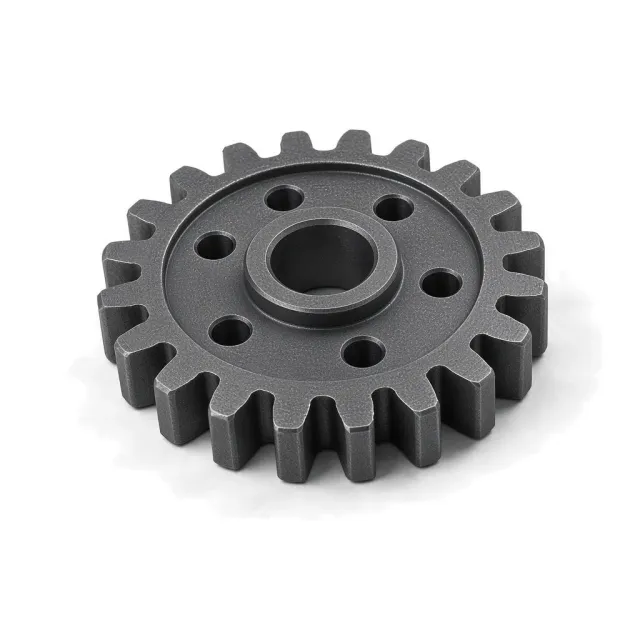
What is Manganese phosphate?
MIL-DTL-16232 Type M defines coating classes by minimum coating weight.
How it works
Activated steel is immersed in a heated acidic manganese-phosphate bath. Controlled substrate dissolution triggers precipitation of manganese-iron phosphate crystals over the surface. The porous crystal network, commonly about 5–20 µm thick, absorbs oil and supplies reservoirs during initial sliding. MIL-DTL-16232 Type M classes are governed by coating weight, including approximately 16 and 22 g/m² minimum levels, rather than a universal thickness. The coating is normally oiled immediately after rinsing and drying.
Why specify it
- Porous 5–20 µm layer retains lubricant
- Improves running-in on gears, cams, and piston parts
- MIL-DTL-16232 controls heavy coating mass
- Reduces scuffing during initial operation
Where it falls short
- Requires oil or seal for useful corrosion protection
- Buildup is unsuitable for unadjusted precision fits
- Not a low-friction coating after oil is exhausted
- Acid preparation can threaten high-strength steel
Manganese phosphate at a glance
Manganese phosphate is a middle-of-the-range finish; its best score is lubricity (60 of 100), at a standard cost. Surface hardness is not rated: the finish leaves the part's own surface.
Each score is 0–100 against every finish in this catalog. Corrosion comes from salt-spray life (ASTM B117, log scale) and hardness from the finish layer's Vickers or pencil hardness; cosmetic, lubricity and cost are FabDigit's engineering assessment. Economy on the radar is the inverse of cost.
Manganese phosphate key numbers
Typical values from the governing specifications and shop practice; bars are this finish against the highest value among black oxide & phosphate finishes.
- Thickness
- Typical 5–20 µm; acceptance is normally by MIL-DTL-16232 coating mass.
- Corrosion (salt spray)
- 24–72 h per ASTM B117 to red rust with supplementary oil (typical) — MIL-DTL-16232 requires under 2 h — the oiled figure is what shops quote.
- Electrical
- Semi-conductive
- Colours
- dark gray
- black
- Appearance
- Matte dark gray to black, becoming darker and slightly glossy after oiling.
Specifications for Manganese phosphate
The documents a drawing cites to define this finish, with the Type / Class rows that apply. Each links to a page explaining the standard, and US Government documents are free to download there.
| Standard | Type / Class | Thickness | Requirement / test | Status |
|---|---|---|---|---|
Phosphate Coating, Heavy, Manganese or Zinc Base · DoD | Type M Class 1 | — | Manganese-phosphate base with a purchaser-specified supplementary preservative treatment or coating. · Heavy manganese-phosphate coating; applicable coating-weight requirement is selected by the controlled specification and order. · Coating weight, coverage, adhesion, and specified supplementary-treatment performance. | Active |
| Type M Class 2 | — | Manganese-phosphate base with specified lubricating oil or Grade 3 corrosion preventive. · Heavy manganese-phosphate coating. · At least 48 h salt spray without corrosion with the required supplementary treatment. | ||
| Type M Class 3 | — | Manganese-phosphate base with no supplementary treatment. · Heavy manganese-phosphate coating. · Coating weight, coverage, adhesion, and visual quality; no oil-based corrosion requirement applies. | ||
| Type M Class 4 | — | Chemically converted manganese-phosphate coating; may be dyed or supplementary-treated when specified. · Heavy manganese-phosphate coating. · At least 72 h salt spray without corrosion when supplementary treatment is applied. |
Drawing call-out
MANGANESE PHOSPHATE PER MIL-DTL-16232 TYPE M, CLASS 1, 22 G/M² MINIMUM COATING WEIGHT; IMPREGNATE WITH PRESERVATIVE OILPattern: PHOSPHATE COAT PER MIL-DTL-16232 TYPE <M|Z>, CLASS <1|2|3|4>, [SUPPLEMENTARY TREATMENT], [COLOR], [MASKING]
Which materials take Manganese phosphate?
Verdict per material family, with the grades that behave differently. Each family links to its datasheets in the material library.
| Material family | Verdict | Notes |
|---|---|---|
| Yes | Carbon and low-alloy steel are the intended substrates.
| |
| With care | Steel DMLS/SLM parts may be processed after density and residual-powder review. | |
| No | This conversion is for ferrous alloys, not aluminum. | |
| No | Brass does not accept this ferrous conversion coating. | |
| No | Copper alloys do not form this ferrous conversion coating. | |
| No | Fused-filament polymers are incompatible with this process. | |
| No | Magnesium is incompatible with this process. | |
| No | Polymer powder-bed prints are incompatible with this process. | |
| No | Organic polymers cannot take this inorganic metal-finishing process. | |
| No | Photopolymer prints are incompatible with this process. | |
| No | Polymer powder-bed prints are incompatible with this process. | |
| No | Ordinary manganese phosphate does not form readily on passive stainless. | |
| No | Titanium is not processed in these ferrous baths. | |
| No | Zinc alloys are not the intended substrate. |
How Manganese phosphate is applied, and what it does to the part
- 1Degrease
- 2Rinse
- 3Pickle / activate
- 4Manganese phosphate
- 5Dry
- 6Oil impregnate
| Dimensions | Allow for approximately 5–20 µm buildup per treated surface; finish-size critical fits after coating where appropriate. |
|---|---|
| Build-up per side | 5–20 µm — Porous crystal buildup varies with coating mass and substrate. |
| Masking | Usually needed. Mask precision journals, tight threads, electrical contacts, and surfaces that must remain oil-free. |
| Electrical | Semi-conductive |
| Appearance | Matte dark gray to black, becoming darker and slightly glossy after oiling. |
| Added lead time | 3–5 working days on top of the bare part |
Design rules for Manganese phosphate
What to decide on the drawing before the part goes to the finisher.
- State coating class and lubricant.The dry porous phosphate is not the complete tribological system.
- Control coating mass.Mass is more repeatable than crystal-layer thickness.
- Compensate 5–20 µm per coated surface.Unplanned buildup can close running clearance.
- Review steel strength and acid activation.High-strength parts may need embrittlement controls.
Manganese phosphate versus the alternatives
Finishes engineers weigh against Manganese phosphate, and when each wins.
| Finish | Corrosion | Hardness | Cosmetic | Cost | Thickness | Choose it when |
|---|---|---|---|---|---|---|
Manganese phosphate this page | 38 | — | 25 | $$ | 5–20 µm | — |
| 38 | — | 18 | $ | 2–15 µm | when paint adhesion is the primary purpose | |
| 38 | — | 55 | $ | 0.5–2 µm | when negligible buildup is required |
The radar overlays Manganese phosphate with Zinc Phosphate, its most common alternative — chosen when paint adhesion is the primary purpose. Scores in the table are 0–100 across every finish in the catalog.
Cost, lead time and compliance
Relative cost
Manganese Phosphate is a standard-cost finish ($$): cheaper than about 71 % of the finishes FabDigit quotes.
Finishing is priced per part with a lot minimum, from FabDigit's own China-side rates cross-checked against US job-shop pricing. The exact figure appears on the instant quote once the part is uploaded.
Lead time and compliance
| Added lead time | 3–5 working days |
|---|---|
| RoHS | Compliant |
| Notes | Typical phosphate coatings can comply; verify oil, accelerator chemistry, and wastewater treatment. |
What Manganese phosphate is used for
- Engine gears
- Camshafts
- Transmission components
- Lubricant-retaining shafts
Manganese phosphate — frequently asked
What does manganese phosphate do?
Its porous crystals hold oil and improve running-in on loaded steel parts. The coating itself is typically 5–20 µm thick.
Does manganese phosphate prevent rust?
Only modestly unless it is saturated with oil or another seal. The porous phosphate is a lubricant carrier, not a standalone outdoor barrier.
How thick is manganese phosphate coating?
A typical range is 5–20 µm. MIL-DTL-16232 controls Type M coating by mass, commonly around 16–22 g/m² minimum depending on class.
Manganese phosphate vs black oxide: which is better?
Manganese phosphate retains more oil and supports wear-in but has more buildup. Black oxide is only about 0.5–2 µm and is preferred for minimal dimensional change.
Can manganese phosphate be used on gears?
Yes, gears and transmission parts are classic applications because the coating carries lubricant during break-in. Tooth geometry must include the 5–20 µm per-surface buildup.