
Nylon Part Dyeing
Colouring & dyeing · Dip / immersion
Nylon part dyeing colors porous SLS and MJF polyamide by immersing finished parts in a heated dye bath.
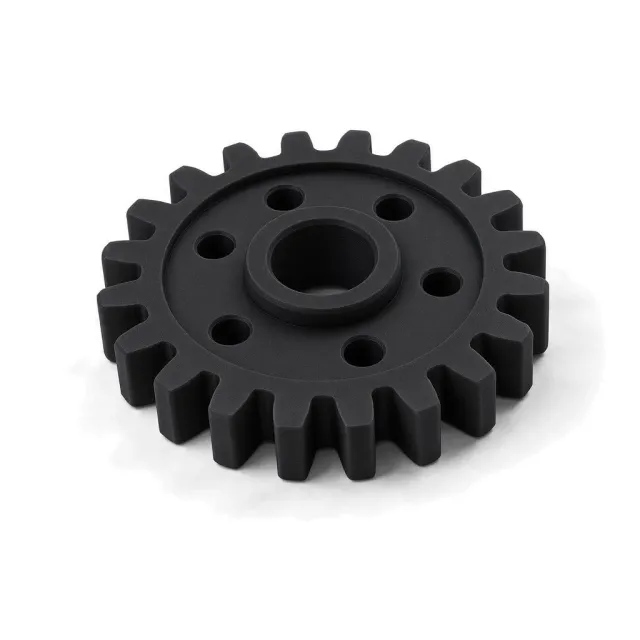
What is Nylon dyeing?
It preserves texture and dimensions better than an opaque paint film and is widely used for black production-like printed parts.
How it works
Depowdered and cleaned nylon parts are immersed in a controlled aqueous dye bath. Heat opens the polymer structure and accelerates diffusion of dye molecules into the near-surface material. Time, temperature, pH, resin grade, prior blasting, wall porosity, and starting color determine shade and penetration. Parts are rinsed and dried after dyeing. Because MJF parts begin gray and SLS parts often begin white, the same dye formula does not produce the same final color on both.
Why specify it
- Adds color with essentially no separate film buildup
- Preserves molded-like texture and fine geometry
- Black hides handling soil and print-to-print color variation
- Scratches are less visually obvious than on an opaque surface paint
Where it falls short
- Bright colors are difficult on gray MJF substrates
- Color depth and penetration vary with print porosity
- Ultraviolet and chemical fade depend on dye chemistry
- Dye does not seal pores or improve mechanical strength
Nylon dyeing at a glance
Nylon dyeing is strongest on cosmetic quality (75 of 100), at a budget cost. It adds little lubricity. Corrosion protection and surface hardness are not rated: a plastic part does not corrode, and the finish leaves the part's own surface.
Each score is 0–100 against every finish in this catalog. Corrosion comes from salt-spray life (ASTM B117, log scale) and hardness from the finish layer's Vickers or pencil hardness; cosmetic, lubricity and cost are FabDigit's engineering assessment. Economy on the radar is the inverse of cost.
Nylon dyeing key numbers
Typical values from the governing specifications and shop practice; bars are this finish against the highest value among colouring & dyeing finishes.
- Electrical
- Unchanged
- Colours
- black
- blue
- red
- green
- custom dark color
- Appearance
- Uniform matte color that retains SLS or MJF surface texture; dark shades are more repeatable than light shades.
Specifications for Nylon dyeing
The documents a drawing cites to define this finish, with the Type / Class rows that apply. Each links to a page explaining the standard.
Drawing call-out
DYE SLS PA12 PARTS BLACK THROUGH CONTROLLED IMMERSION PROCESS; MATCH APPROVED MASTER FD-ND-004 UNDER D65/10°; NO PAINT FILM; PROTECT IDENTIFIED BOND AREASWhich materials take Nylon dyeing?
Verdict per material family, with the grades that behave differently. Each family links to its datasheets in the material library.
| Material family | Verdict | Notes |
|---|---|---|
| Yes | Common for black and other dark colors.
| |
| Yes | Best established on porous PA11 and PA12 parts.
| |
| With care | Filled nylon may absorb dye unevenly. | |
| With care | Only compatible absorbent nylon grades should be included.
| |
| Limited | Only FDM nylon grades, and colour is often uneven at layer lines. | |
| No | Nylon dye does not colour metals. | |
| No | Nylon dye does not colour metals. | |
| No | Nylon dye does not colour metals. | |
| No | Metal AM cannot be nylon-dyed. | |
| No | Nylon dye does not colour metals. | |
| No | Photopolymer resin does not use the nylon immersion-dye mechanism. | |
| No | Nylon dye does not colour metals. | |
| No | Nylon dye does not colour metals. | |
| No | Nylon dye does not colour metals. | |
| No | Nylon dye does not colour metals. |
How Nylon dyeing is applied, and what it does to the part
- 1Depowder
- 2Blast and clean
- 3Dry
- 4Prepare dye bath
- 5Immerse under controlled cycle
- 6Rinse
- 7Dry and condition
- 8Inspect color
| Dimensions | No intentional film buildup, so threads and fits are usually preserved; moisture and thermal conditioning can still change nylon dimensions. |
|---|---|
| Build-up per side | 0 µm — Dye diffuses into nylon and creates no intentional film buildup. |
| Masking | Usually needed. Mask only where dye exclusion is functionally required; porous nylon may make sharp mask lines difficult. |
| Electrical | Unchanged |
| Appearance | Uniform matte color that retains SLS or MJF surface texture; dark shades are more repeatable than light shades. |
| Added lead time | 2–5 working days on top of the bare part |
Design rules for Nylon dyeing
What to decide on the drawing before the part goes to the finisher.
- Approve separate color masters for SLS and MJF.White SLS and gray MJF starting colors shift the same dye differently.
- Specify polymer grade and print process.Dye uptake changes with resin and porosity.
- Condition nylon before final dimensional inspection.Immersion and drying change moisture content.
- Do not claim sealing from dyeing.Absorbed color does not close interconnected porosity.
Nylon dyeing versus the alternatives
Finishes engineers weigh against Nylon dyeing, and when each wins.
| Finish | Corrosion | Hardness | Cosmetic | Cost | Thickness | Choose it when |
|---|---|---|---|---|---|---|
Nylon dyeing this page | — | — | 75 | $ | — | — |
| 59 | 10 | 90 | $$ | 20–80 µm | when an exact bright color or smooth filled surface is required | |
| 15 | — | 92 | $$ | 15–50 µm | when transparent surface color rather than absorbed nylon dye is needed |
The radar overlays Nylon dyeing with Wet Painting, its most common alternative — chosen when an exact bright color or smooth filled surface is required. Scores in the table are 0–100 across every finish in the catalog.
Cost, lead time and compliance
Relative cost
Nylon Part Dyeing is a budget-cost finish ($): cheaper than about 85 % of the finishes FabDigit quotes.
Finishing is priced per part with a lot minimum, from FabDigit's own China-side rates. The exact figure appears on the instant quote once the part is uploaded.
Lead time and compliance
| Added lead time | 2–5 working days |
|---|---|
| RoHS | Compliant |
| Notes | Confirm exact dye formulation, wastewater handling, and restricted substances. |
What Nylon dyeing is used for
- SLS PA12 housings
- MJF PA12 production parts
- Wearable prototypes
- Clips and brackets
- Black presentation models
Nylon dyeing — frequently asked
can SLS nylon be dyed
Yes. Porous SLS PA12 accepts heated immersion dye well, especially dark colors such as black. The process adds no intentional coating thickness.
can MJF parts be dyed bright colors
MJF PA12 starts gray, which limits clean bright shades. Dark blue, dark green, and black are more practical than yellow or pastel colors.
does dyeing change nylon dimensions
There is no separate film buildup, so thread and fit geometry is largely preserved. However, heated immersion and moisture conditioning can cause temporary dimensional change in nylon.
does nylon dye scratch off
Dye penetrates below the immediate surface, so a light scratch is less obvious than on opaque paint. Deep abrasion can still expose differently colored material if penetration is limited.
does dyeing waterproof SLS parts
No. Dye adds color but does not seal connected pores. Use a validated sealing or smoothing process when pressure or leak tightness is required.